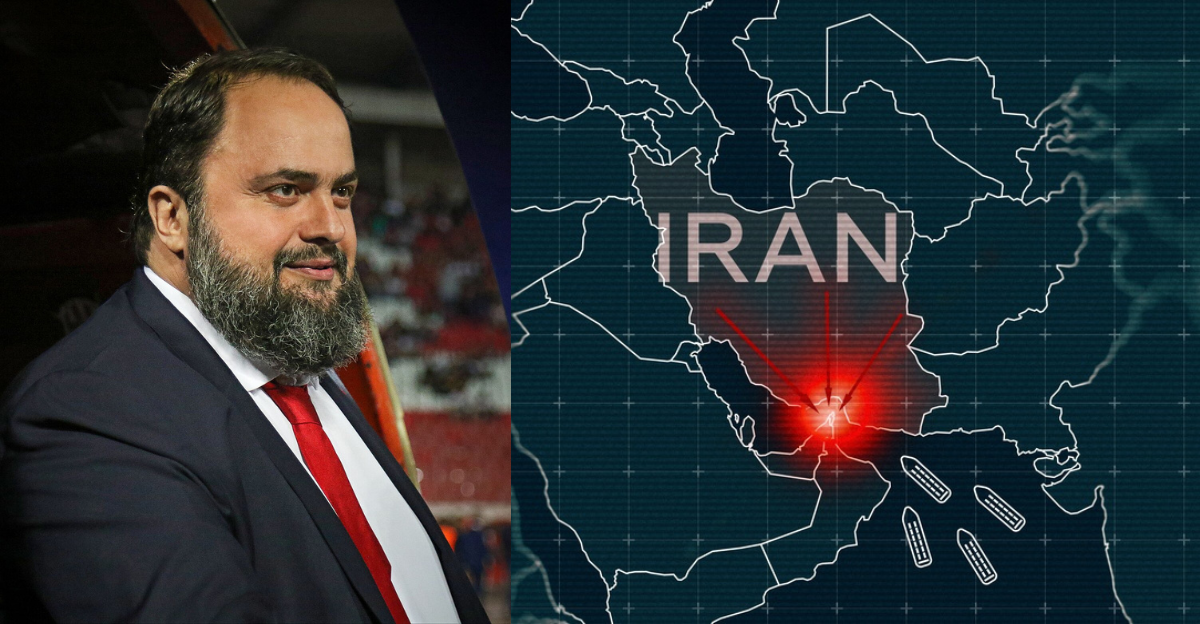
Evangelos Marinakis, the Greek shipping magnate who owns football clubs Nottingham Forest and Olympiacos Pireu, has ignited an international debate by expressing his willingness to pay Iran a transit fee to ensure the continued passage of vessels through the strategic Strait of Hormuz.
Marinakis, whose Capital Maritime Group commands a fleet of 185 vessels including approximately 35 tankers, made his controversial remarks at a forum organized by TradeWinds News during the Posidonia maritime event in Athens on Tuesday. He suggested a payment of $100,000 or $200,000 per vessel, varying with cargo or ship size, as a pragmatic solution to ongoing geopolitical tensions.
“For me, it is better to pay a fee of $100,000 or $200,000, depending on the size of the cargo or the size of the vessel, than to have all this hassle,” Marinakis stated, according to the Financial Times and Middle East Eye. He further elaborated that such a fee could potentially compensate Iran for “damages” incurred from the US-Israel war, believing it preferable to a closed waterway. “Even if we had to pay a fee, for me [it would] be much better than to have the straits closed.”
A stance at odds with governments
Marinakis’s proposal places him directly at odds with both the Trump administration and his own Greek government. Greek Prime Minister Kyriakos Mitsotakis publicly stated in May that Iran should not impose any toll in the vital waterway. The United States has consistently rejected any Iranian attempt to levy a toll on this strategic maritime route.
Read also: Thierry Henry issues blunt warning over Liverpool’s £123m signing
The Strait of Hormuz, a narrow passage just 21 nautical miles wide at its most constricted point, is a critical artery for global commerce, historically handling around 20% of the world’s crude oil and liquefied natural gas (LNG) deliveries. International maritime law, specifically the United Nations Convention on the Law of the Sea, prohibits countries whose coasts border international straits from restricting transit or charging tolls. While countries can claim up to 12 nautical miles for their territorial waters, Iran’s consistent insistence on its right to impose a toll as part of any agreement to end the war remains a point of contention.
Divergent views among shipping magnates
Marinakis’s view is not universally shared within the influential Greek shipping community, which controls approximately 20% of the global shipping fleet. Fellow Greek shipping magnate George Procopiou, whose company Dynacom is one of the few that has sent vessels through the Strait during the current conflict, firmly rejected the idea of a transit fee. Procopiou cited a long-standing tradition among Greek sailors of “breaking blockades.”
Despite the official stance, reports from the Middle East Eye suggest that some shipowners have already resorted to paying transit fees to Iran, reportedly in Chinese yuan. Legal experts propose that Iran might sidestep international prohibitions by implementing “piloting fees” or “fees for service” if it secures cooperation from Oman, the only other nation whose territorial waters extend over the strait.
Sources: www.ft.com, www.middleeasteye.net
Read also: Roy Keane goes nuclear on Man City after 114 guilty findings
Read also: Here is Foden’s Man City exit route