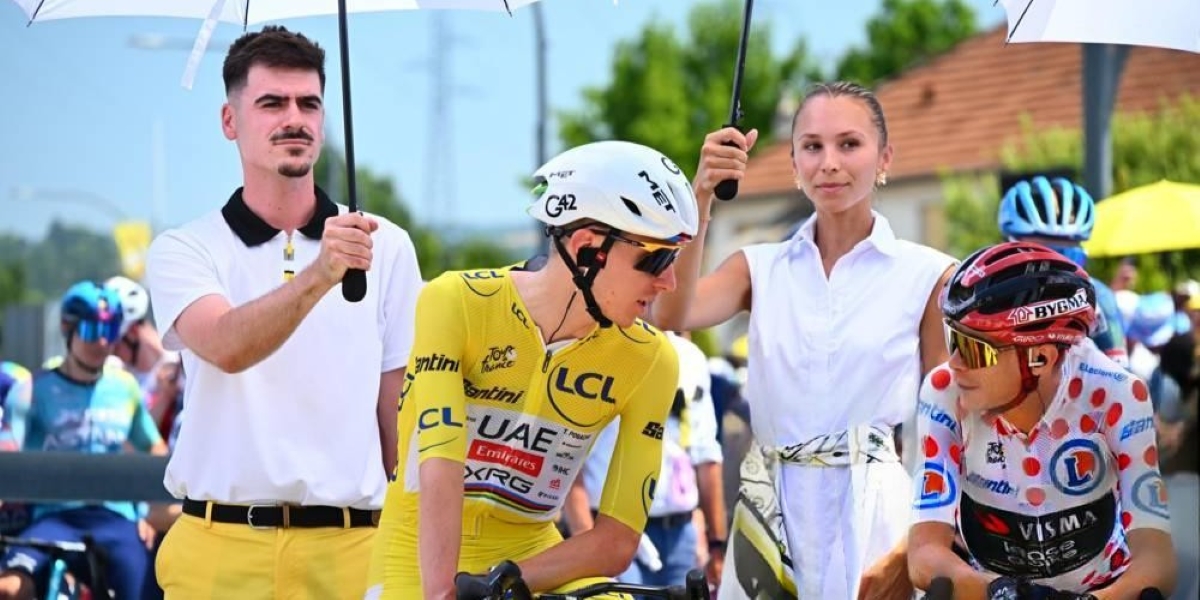
Victory brings familiar questions
Tadej Pogačar’s latest Tour de France triumph confirmed his place among cycling’s greatest riders.
The Slovenian secured his fifth overall title in Paris, equalling the men’s race record shared by Jacques Anquetil, Eddy Merckx, Bernard Hinault and Miguel Indurain.
According to the Associated Press report on the final stage, Pogačar finished six minutes and 26 seconds ahead of Remco Evenepoel.
Yet the celebrations were once again accompanied by questions about doping controls and the credibility of elite cycling.
Read also: Coleen Rooney recounts awkward Trump encounter, Ian Wright calls him a 'freak'
Scrutiny since his Tour debut
Pogačar first competed in the Tour in 2020 and has faced extensive testing throughout each of his seven appearances.
Speaking after the 2026 race, he said the controls had sometimes taken place at surprising and inconvenient moments.
“Since my first Tour in 2020, we have been through the strangest checks,” Pogačar said.
His comments were not a complaint about being tested, but an account of how unpredictable the process has become.
Read also: Britain’s new PM says Glasgow saved Commonwealth Games from collapse
Tests before major mountain stages
Some of the most unusual controls, Pogačar said, came shortly before the start of decisive mountain stages.
“I think it has happened four or five times in the seven Tours I have ridden,” he said.
“They have been waiting outside the team bus half an hour before the stage.”
As quoted by Tom van der Salm in his report for IDL Pro Cycling, Pogačar found those pre-stage visits even stranger than the widely discussed nighttime control.
Read also: Portugal’s new president hails stunning triple gold breakthrough
A knock at five in the morning
The most controversial test of the 2026 Tour came before stage 15, when officials visited Pogačar at around 5 a.m.
Jonas Vingegaard was tested even earlier, at approximately 2 a.m. The controls interrupted both riders’ sleep before one of the race’s hardest mountain stages.
Pogačar later said he had slept for only four hours and had been unable to fall asleep again after the officials left.
The timing drew criticism from riders who argued that testing should not interfere with recovery or performance.
Read also: Kyle Shanahan's serious car crash went undisclosed for 11 days
Judicial approval was required
The controls took place outside the usual testing window of 6 a.m. to 11 p.m.
A Paris judge therefore had to approve the operation after a request from the International Testing Agency.
As described by The Guardian’s report on the nighttime tests, French law requires special authorisation for anti-doping controls carried out during those hours.
Neither the timing nor the authorisation meant that either rider had committed an anti-doping violation.
Read also: German president makes stunning U-turn over Hitler-era Olympic anniversary
Testing has become routine
Despite the inconvenience, Pogačar said he has become accustomed to seeing anti-doping officials throughout the season.
“It is part of my routine now,” he said.
“When there is a knock on the door early in the morning, my first thought is that it is a doping control.”
For one of the most closely watched athletes in cycling, testing is no longer an exceptional event.
As ordinary as visiting a supermarket
Pogačar used a simple comparison to explain how normal the process now feels.
“For me, it is like going to the supermarket. It is nothing unusual anymore,” he said.
“I have been tested so many times over the past few years that it has become part of my life.”
The comment reflected familiarity rather than indifference. Pogačar accepts that repeated testing comes with his position at the top of the sport.
Cycling’s history remains present
Cycling’s long history of doping scandals continues to shape the way outstanding performances are viewed.
Tour winners face particularly close attention, while anti-doping authorities are under pressure to show that even the sport’s biggest names are subject to rigorous controls.
Pogačar’s dominance naturally attracts questions, but the frequency of his tests is not evidence of wrongdoing.
It instead illustrates how far the sport is prepared to go in its attempt to protect public confidence.
Support for testing, concern over timing
Pogačar has made clear that he supports strong anti-doping measures.
His concern is mainly about controls that interrupt sleep or take place immediately before a demanding stage.
The International Testing Agency has acknowledged that nighttime tests can disturb riders, while maintaining that controls outside normal hours may sometimes be necessary.
That leaves cycling searching for a balance between effective enforcement and the welfare of the athletes being tested.
An accepted burden at the top
Pogačar ended the Tour with another yellow jersey and another round of questions about the sport’s integrity.
He did not avoid the subject or argue that leading riders should receive special treatment.
Instead, he described anti-doping controls as an unavoidable part of his profession, even when their timing seems extreme.
For Pogačar, the repeated knock at the door has become another feature of life as the most successful rider of his generation.


