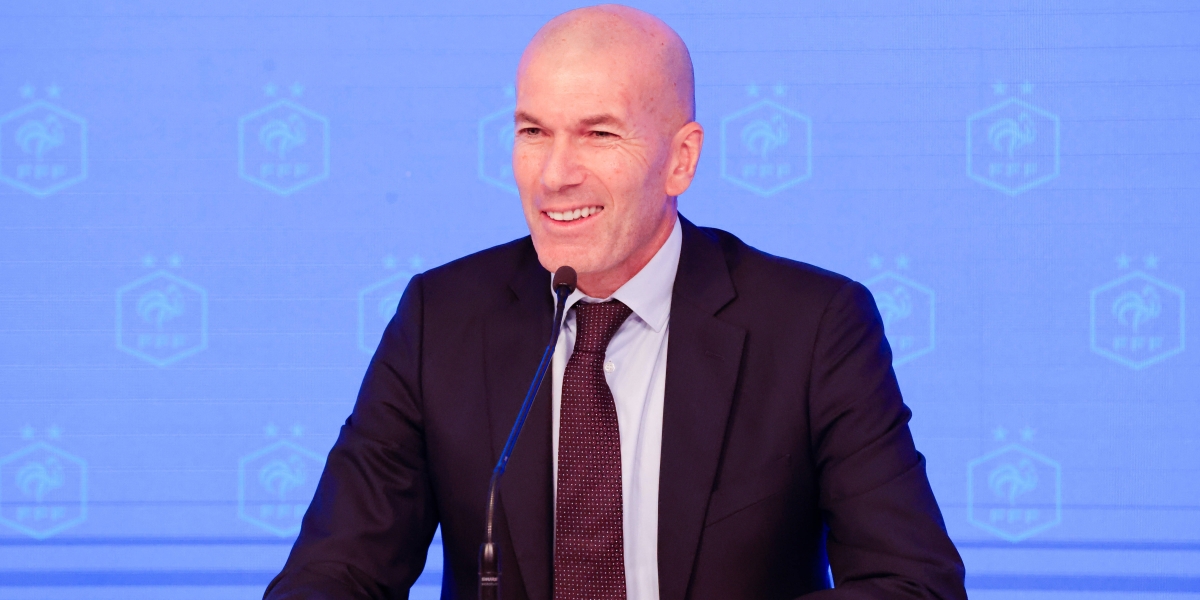
Zinédine Zidane’s appointment as France manager is more than a conventional change in the dugout.
It is the return of a national symbol, the beginning of a new era for one of international football’s strongest squads and the most important test of Zidane’s coaching career.
The French Football Federation confirmed that Zidane has signed a four-year contract running until the end of the 2030 World Cup. He officially begins work on 1 August 2026, succeeding Didier Deschamps after 14 years under the former France captain.
His first match will be away against Turkey in the Nations League on 25 September. Belgium, Italy and Turkey will also provide significant early tests during a demanding first international window.
Read also: Toto Wolff makes major decision on Max Verstappen's potential Mercedes move
“There is nothing greater than the France national team,” Zidane said after accepting the position.
For a man who has won virtually everything football can offer, that sentence explains why he rejected other opportunities and waited for this particular job.
Who is Zinédine Zidane?
Zinédine Yazid Zidane was born in Marseille on 23 June 1972 and was 54 when he became France manager.
He grew up in La Castellane, a working-class district in northern Marseille, in a family of Algerian origin. His upbringing became a central part of his public identity. Zidane was not raised inside football’s traditional elite. He came from an environment where discipline, family loyalty and hard work mattered more than celebrity.
Read also: Messi's December interview is being read again in Buenos Aires, and one line explains why
Those characteristics followed him throughout his career.
Away from the pitch, Zidane was often quiet and guarded. On it, he demanded responsibility. He wanted the ball when matches became tense, controlled their rhythm and appeared most comfortable when the pressure was at its greatest.
His personality as a coach has followed the same pattern. He rarely seeks attention, but players quickly understand who carries the authority in the room.
From Marseille to the professional game
Zidane began playing for local clubs before joining Cannes as a teenager. He made his French top-flight debut at 17 and gradually established himself as one of the country’s most gifted young midfielders.
Read also: Elijah Bieniemy charged in shooting of mother, Chiefs assistant Eric Bieniemy absent from practice
In 1992, he joined Bordeaux. It was there that he developed from an elegant prospect into an internationally recognised playmaker.
Alongside players such as Christophe Dugarry and Bixente Lizarazu, Zidane helped Bordeaux reach the 1996 UEFA Cup final. Although Bayern Munich won the final, the campaign convinced Europe’s leading clubs that Zidane was ready for a bigger stage.
His professional club career eventually took him through four teams: Cannes, Bordeaux, Juventus and Real Madrid. The FFF’s official career record also credits him with 108 senior appearances and 31 goals for France.
Juventus turned him into a global superstar
Zidane moved to Juventus in 1996, entering a league that was then considered the most tactically demanding in world football.
Read also: Trump’s Iran escalation sends Formula 1 into extraordinary Malaysia rescue
Italian football made him more complete. His technique had never been in doubt, but Juventus demanded greater tactical awareness, defensive discipline and consistency. Victory was not treated as a pleasant outcome in Turin. It was an obligation.
Zidane won Serie A in 1997 and 1998, as well as the UEFA Super Cup and Intercontinental Cup. He also reached two consecutive Champions League finals, losing to Borussia Dortmund in 1997 and Real Madrid in 1998.
That same year, he won the Ballon d’Or after leading France to the World Cup.
By then, Zidane was no longer merely an exceptional player. He was arguably the defining midfielder of his generation.
Read also: Toto Wolff erupts at ‘Teletubbies engineers’ after F1 system failure
The night he became immortal in France
Zidane made his senior France debut against the Czech Republic in August 1994. France were 2-0 down when he entered the match, but the young midfielder scored twice to secure a 2-2 draw.
Four years later, he delivered the performance that transformed him into a national hero.
France faced Brazil in the 1998 World Cup final at the Stade de France. Zidane scored two first-half headers as the hosts won 3-0 and lifted the World Cup for the first time.
After the victory, his face was projected onto the Arc de Triomphe. The Marseille-born son of Algerian parents had become a symbol of sporting success and of the multicultural France represented by that team.
France had other great players, including Deschamps, Marcel Desailly, Lilian Thuram and Emmanuel Petit. Zidane, however, became the image of the triumph.
His finest tournament may have come two years later
Despite the significance of 1998, Zidane believed he played his best international football at Euro 2000.
France arrived as world champions and faced the challenge of becoming European champions as well. Zidane controlled matches with an authority that few players have displayed at a major tournament.
He scored a free kick against Spain in the quarter-final and converted the golden-goal penalty against Portugal in the semi-final. France then defeated Italy in the final.
UEFA later described his tournament as a level of individual domination rarely seen since Diego Maradona at the 1986 World Cup.
That competition showed Zidane in his most complete form. He was creative without becoming careless, physically strong without losing elegance and capable of slowing down or accelerating a match almost whenever he chose.
The night English supporters will never forget
English readers may remember Zidane most vividly for what happened in Lisbon at Euro 2004.
England led France 1-0 through Frank Lampard and appeared to be closing in on an important group-stage victory. David Beckham had even been given the chance to make it 2-0 from the penalty spot, only for Fabien Barthez to save his effort.
Then Zidane took control.
He equalised with a free kick in the first minute of stoppage time. Two minutes later, he scored a penalty after David James brought down Thierry Henry.
France had turned defeat into a 2-1 victory within a matter of minutes. UEFA later described it simply as a night that belonged to Zidane.
The irony was that Beckham was not merely an opponent. The England captain joined Zidane at Real Madrid that same summer and became part of the Galácticos alongside Ronaldo, Luís Figo, Raúl and Roberto Carlos.
Real Madrid and one of football’s greatest goals
Real Madrid signed Zidane from Juventus in 2001 for what was then a world-record transfer fee.
He arrived with almost every major honour already secured, but the Champions League was still missing from his collection.
That changed in 2002.
Real Madrid faced Bayer Leverkusen at Hampden Park in Glasgow. With the score at 1-1, Roberto Carlos sent a high ball towards the edge of the penalty area. Zidane watched it drop and struck a left-footed volley into the top corner.
Madrid won 2-1, and the goal became one of the most celebrated in the competition’s history.
Zidane played 227 official matches and scored 49 goals for Real Madrid. He won the Champions League, La Liga, the Intercontinental Cup, the UEFA Super Cup and two Spanish Super Cups before retiring in 2006.
A brilliant career ended in Berlin
Zidane initially retired from international football in 2004 but returned to help France qualify for the 2006 World Cup in Germany.
At 34, he produced one final extraordinary tournament. France eliminated Spain, Brazil and Portugal before facing Italy in the Berlin final.
Zidane scored an audacious Panenka penalty, but his final appearance ended in controversy when he was sent off for headbutting Marco Materazzi during extra time.
France lost the penalty shootout.
The dismissal remains inseparable from his story. It exposed the temper that occasionally existed beneath his calm exterior. Yet Zidane was still voted the tournament’s best player and received the Golden Ball.
It was an imperfect ending to an extraordinary playing career.
From assistant to history-making manager
Zidane remained closely connected to Real Madrid after retiring.
He worked as an adviser, sporting director and assistant to Carlo Ancelotti. He was part of the coaching staff when Madrid won the Champions League in 2014 before taking charge of Real Madrid Castilla.
In January 2016, he replaced Rafael Benítez as first-team manager.
Within five months, he was a Champions League-winning coach.
Real Madrid retained the trophy in 2017 and won it again in 2018, making Zidane the first manager to win three consecutive Champions League titles in the competition’s modern era.
The third came against Liverpool in Kyiv. Gareth Bale, whom Zidane introduced from the bench, scored twice in a 3-1 victory, including his famous overhead kick. For English supporters, it was another night when Zidane stood between a Premier League team and European glory.
Across his two periods as Madrid manager, Zidane won 11 trophies: three Champions Leagues, two La Liga titles, two Club World Cups, two UEFA Super Cups and two Spanish Super Cups.
What kind of manager is he?
Zidane is not usually presented as a rigid tactical ideologue.
He used different structures at Real Madrid, including 4-3-3, 4-4-2 and a midfield diamond. His decisions were based on the players available and the demands of individual matches.
His greatest quality was his management of elite personalities.
Cristiano Ronaldo, Sergio Ramos, Luka Modrić, Toni Kroos, Karim Benzema, Bale and Marcelo all had different needs and different levels of status. Zidane created a structure in which those personalities could coexist.
He gave players freedom but expected responsibility. He understood when a squad needed tactical information and when it needed calm. Most importantly, his players knew that he had personally experienced the pressure they were facing.
Zidane has said that France’s football will resemble his Real Madrid teams. He wants attacking football and goals, but also insists that the side must retain its balance.
Does the current France squad respect him?
Zidane enters the France dressing room with an unusual level of natural authority, but admiration and everyday management are not the same thing.
The clearest public example is captain Kylian Mbappé.
After scoring a hat-trick for Real Madrid against Manchester City in 2025, with Zidane watching from the stands, Mbappé said: “Zizou is an idol for me. He means a lot.”
Mbappé added that making Zidane smile through his football made him immensely happy.
That admiration gives Zidane a strong starting point, particularly because Mbappé is both France’s captain and its biggest star.
However, Zidane must still make difficult decisions. He must define the captaincy, manage playing time, leave established players out of squads and build relationships with individuals who may have admired him without ever working under him.
Respect will open the dressing-room door. Results and fairness will determine whether it remains united.
He has waited almost five years for this moment
Zidane had not coached since leaving Real Madrid in May 2021.
His absence created questions about whether football had moved forward without him. Pressing systems, data analysis and physical preparation have continued to develop, while Zidane has spent years away from daily coaching.
His explanation is simple. He was waiting for France.
“I spent the last four or five years waiting for this day,” he said during his presentation. He revealed that he could have accepted club projects but chose not to because the national team was the position he wanted.
International management may suit his strengths. National-team coaches have limited training time, meaning communication, authority, flexibility and emotional management become particularly important.
Those are precisely the qualities that defined his greatest years at Real Madrid.
The expectation is simple: France must win
Zidane is not inheriting a broken team.
Deschamps left behind a squad containing world-class quality, major-tournament experience and extraordinary depth. Mbappé, Ousmane Dembélé, Michael Olise, Désiré Doué and several other attacking talents give Zidane options few international managers possess.
That strength also creates pressure.
A quarter-final will be viewed as failure. A semi-final may not be enough. Zidane has been appointed because France believe he can win the European Championship and the World Cup.
As a player, he gave France its first world title.
As a manager, he will now attempt to join the tiny group of men who have won the World Cup both on the pitch and in the dugout.
France have not appointed Zidane to celebrate the past.
They have appointed him to create another historic future.


