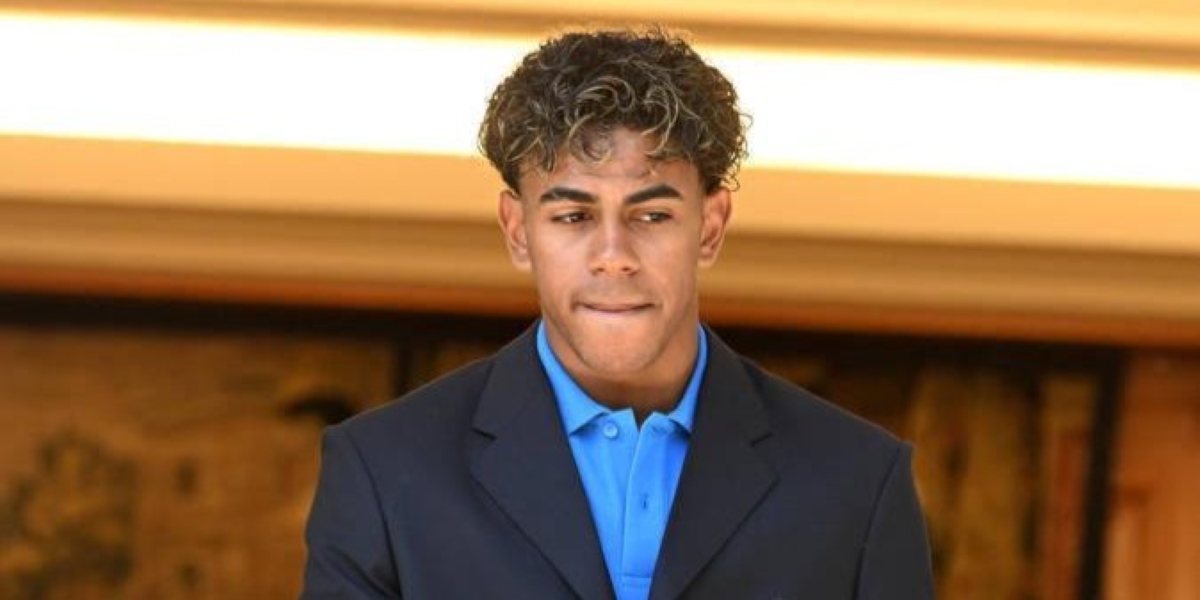
King Felipe VI had already watched Lamine Yamal become a world champion in New Jersey. Less than 24 hours later, the Spanish monarch welcomed the teenager back to Madrid in a manner that quickly became one of the most shared images of the celebrations.
Most members of Spain’s squad approached the royal family with a conventional handshake and a brief exchange. Yamal instead exchanged a dap-style greeting with Felipe before the two embraced warmly, temporarily making the reception at Zarzuela Palace resemble a dressing-room celebration.
The moment was not necessarily an official breach of royal protocol. It was, however, noticeably less formal than the greetings that had preceded it and showed how naturally Spain’s 19-year-old star now moves between football, celebrity and national institutions.
The king adapted to Yamal’s generation
According to Luis Linaza in La Razón’s account of the reception, the Spanish players had been greeting the royal family formally until Yamal reached the front of the line. The newspaper described the subsequent handshake and embrace as a greeting between friends.
Read also: Kylian Mbappe had just hit top form – now Real Madrid have a problem
The informality was mutual. Felipe did not appear surprised or uncomfortable, but immediately followed Yamal’s rhythm and completed the greeting before pulling him closer.
Body-language specialist Javier Torregrosa described the gesture as a dap, a greeting associated with friendship and youth culture. Quoted by El Comercio in its analysis of the embrace, Torregrosa said the gesture moved away from formality and communicated “friendship and closeness”.
The same warmth had been visible during the medal ceremony after the World Cup final. The greeting at Zarzuela was therefore not an isolated surprise, but a continuation of a relationship that appeared unusually relaxed in public.
Spain’s champions went straight from the airport to the palace
The Spanish delegation visited Zarzuela Palace on July 20 after returning from the United States. Felipe, Queen Letizia, Princess Leonor and Infanta Sofía received the team alongside the World Cup trophy.
Read also: Premier League boss breaks silence with damning Manchester City statement
The royal family had attended Spain’s 1-0 extra-time victory over Argentina in New Jersey. At the palace, the federation presented Felipe with a new national-team shirt displaying two stars to mark the titles won in 2010 and 2026.
As described in the Spanish football federation’s official report, the king called the campaign “an odyssey” and “an epic triumph”. He praised the team for combining courage, intelligence and technical quality while remaining faithful to its style.
“You were a team in every sense of the word, united, generous and worthy champions,” Felipe told the squad. “Those two stars will forever belong to Spain, and you are now a legendary team in the history of Spanish sport.”
A teenager who no longer appears intimidated
Yamal had turned 19 during the World Cup and entered the final as one of the most famous young athletes in the world. He had already won the European Championship, become a central figure for Barcelona and learned to live with comparisons to some of football’s greatest players.
Read also: Kasper Schmeichel finds completely new path after football retirement
The reception illustrated how little the surroundings appeared to affect him. A palace, a monarch and an official audience did not change the body language he might have used when greeting a teammate.
That confidence could easily have appeared disrespectful if the king had responded differently. Instead, Felipe’s willingness to adopt the same greeting turned it into a symbol of connection rather than confrontation.
The image presented a modern version of royal recognition. The institution did not require the footballer to become more formal; the monarch briefly entered the player’s world.
The celebration belonged to a new Spain
The reception was followed by a visit to the Moncloa Palace and an open-top bus parade through Madrid. Almost two million people joined the celebrations as Spain marked its first men’s World Cup title in 16 years.
Read also: Andy Murray reveals one major regret about Nadal and Djokovic
Yamal’s background made his embrace with the king particularly powerful for some Spanish commentators. The Barcelona forward grew up in Rocafonda, a neighbourhood in Mataró, and has Moroccan and Equatorial Guinean family roots.
Journalist Rosa Villacastín described the images of Felipe embracing Yamal and Nico Williams as representations of inclusion and national unity. She argued that those scenes reflected the Spain for which people should continue to work.
The photograph did not erase Spain’s political or social divisions. It did capture a country willing, for one afternoon, to allow a teenager from Rocafonda to greet its king entirely on his own terms.
Read also: Manchester United told to ‘nick’ two Man City stars if relegation hits