Drivers immediately questioned the start
The Dutch Grand Prix descended into chaos almost as soon as it began. Rain had passed over Zandvoort shortly before the race, leaving most of the circuit dry enough for slick tyres but several sections significantly wetter. According to Motorsport.com, Pierre Gasly, Liam Lawson and other drivers questioned why the FIA sent the field around behind the safety car for the formation lap before still choosing a normal standing start. Motorsport.com: F1 drivers question the FIA’s Dutch GP start procedure
The issue was tyre temperature. Drivers cannot push as hard behind a safety car as they can during a normal formation lap, which limited their opportunity to generate heat in the slick tyres before stopping on the grid. Gasly said he would have preferred “a normal out-lap, so we would have pushed a bit faster”, while Lawson was even more direct: “To do a standing start and also do a lap behind the safety car makes no sense.”
That concern became significant because conditions were extremely unusual. Most of the lap had already dried, but the final part of the circuit remained treacherous. Gabriel Bortoleto later described the last corner as effectively suitable for full wet tyres despite the rest of the circuit being dry enough for slicks.
The FIA explains its unusual decision
The FIA did not choose the procedure without checking the circuit. Motorsport.com reported that race control took the unusual step of sending the medical car out for a reconnaissance lap shortly before the start. Feedback indicated standing water at Turns 2 and 3, with Turn 3 particularly relevant because the Hugenholtz corner is banked.
Read also: Harry Kane breaks silence on Man City verdict
Based on that information, officials decided that following the safety car for the formation lap was the safer option. Crucially, the procedure also allowed race control to keep both possible starts available. If conditions remained too dangerous, the FIA could have switched to a rolling start rather than sending the cars back to a standing start.
RacingNews365 also reported that rain arrived roughly 45 minutes before the start and that the entire field ultimately chose slick tyres as conditions improved. The FIA’s intervention therefore came during a rapidly changing weather situation rather than on a circuit that was uniformly wet. RacingNews365: How the chaotic Dutch Grand Prix unfolded
Verstappen takes full responsibility
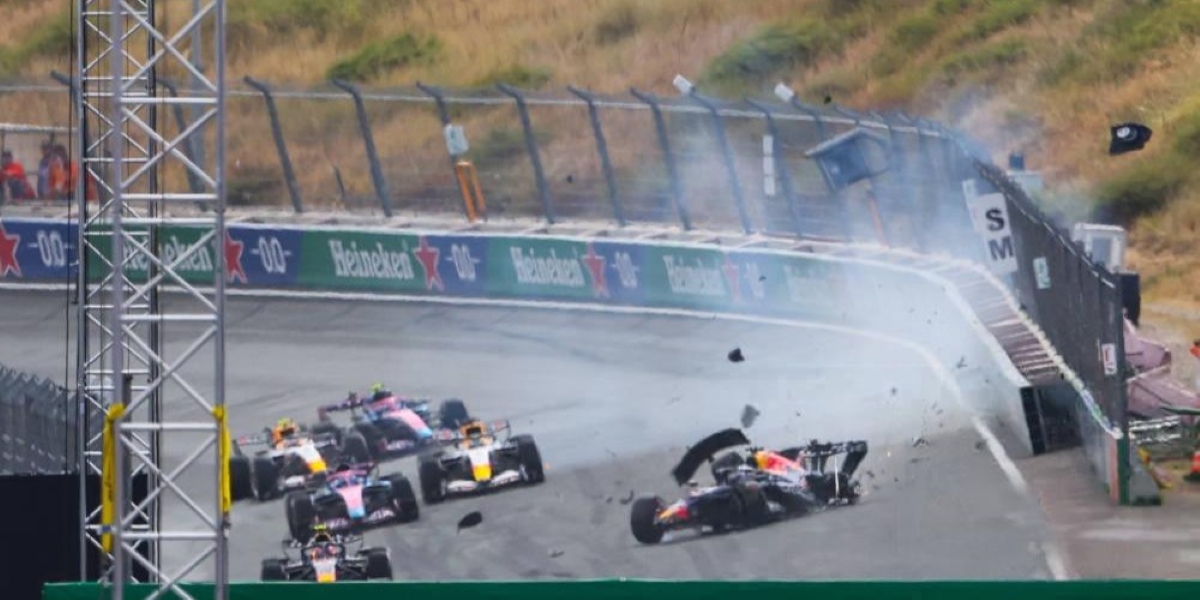
The criticism of the FIA does not mean Verstappen blamed race control for his accident. The four-time world champion started seventh and survived a crowded opening sequence before reaching Zandvoort’s fast banked final corner. There, his Red Bull touched the wetter inside section, snapped sideways and crashed heavily into the outside barrier.
Formula One’s official account confirmed that Verstappen was unhurt despite the significant impact. The Dutchman explained afterwards that he had misjudged the available grip rather than pointing towards the start procedure, while describing both the pace of his car and the end of the weekend as disappointing. Formula 1: Verstappen reacts to his dramatic Zandvoort crash
Read also: Phil Taylor comes out of retirement for stunning darts return
His crash brought out the red flag after only one lap and ended his final scheduled Formula One home race at Zandvoort. The official Formula One race report confirmed that Lando Norris ultimately won from Kimi Antonelli and George Russell once the race resumed. Formula 1: Official Dutch Grand Prix race report
Verstappen was not the only driver caught out
The most important point for the FIA debate is that Verstappen’s mistake was not an isolated sign of poor judgement. Bortoleto also completely lost control through the same final corner moments later. His Audi spun across the track and was fortunate not to be hit by teammate Nico Hülkenberg, who said over the radio that he feared he was going to T-bone the Brazilian.
Lawson said he deliberately left substantially more margin through the corner because he had almost no confidence in the grip available. Carlos Sainz offered a slightly different perspective, arguing that even a rolling start might not have prevented the problem because the field would still have reached the soaked final corner individually.
That leaves the FIA facing a more nuanced question than whether it directly caused Verstappen’s crash. Verstappen has already accepted that the accident was his mistake. The issue is whether a safety procedure that reduced the drivers’ ability to warm their slick tyres was the best solution when one part of the circuit remained dramatically wetter than the rest.
Read also: ‘If you lie to me, I will leave’: Guardiola’s City warning takes on new weight
Read also: Harry Kane’s Bayern future suddenly comes with a Tottenham escape route