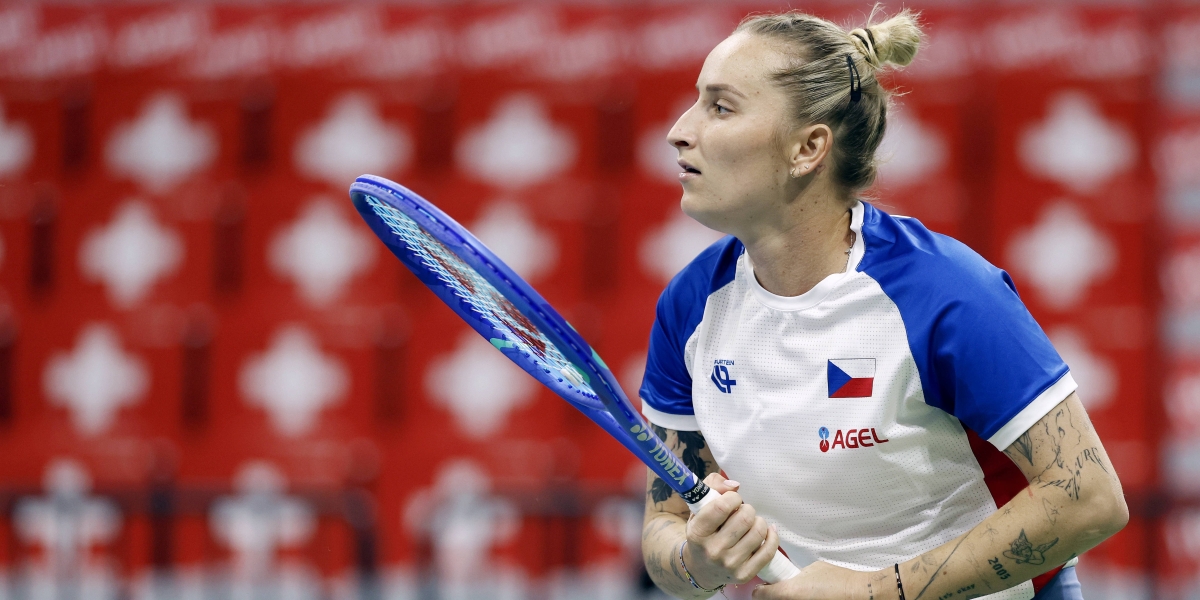
Marketa Vondrousova has formally challenged the four-year ban that has kept her off the WTA Tour since January, with CAS confirming on Tuesday that it has received her appeal. No hearing date has been set.
The Czech, who won Wimbledon as an unseeded outsider in 2023 and once reached No. 6 in the world, is currently ranked No. 153 and faces a suspension that, if upheld, runs until 21 June 2030. She has not played since withdrawing from the Adelaide International in January 2026 with a shoulder injury.
Her only route back is Lausanne. Under the World Anti-Doping Code, refusing to provide a sample carries the same starting sanction as testing positive for a banned substance, and only CAS can now reduce or overturn the ban.
A December evening in Prague
The case turns on a single evening. A doping control officer arrived at Vondrousova’s home shortly after 8pm on 3 December 2025 to carry out an out-of-competition test. She refused to open the door, and the International Tennis Integrity Agency later ruled that the refusal itself was the violation.
Read also: Harry Kane’s Bayern future suddenly comes with a Tottenham escape route
Vondrousova has never disputed that she turned the officer away. What she disputes is that she should be treated as a doper for it.
“I reached breaking point after months of physical and mental stress,” she said in her defense, arguing that the late visit felt like an intrusion on her privacy and safety.
She has invoked the 2016 knife attack on her compatriot Petra Kvitova, who was assaulted by an intruder at her own home, as part of her explanation for not opening the door to a stranger after dark.
“After what happened to Petra, we don’t take strangers at our door lightly,” she said.
Read also: ‘I’m not confident’: Red Bull chief delivers troubling verdict on Verstappen’s car
A test she took on 7 December came back negative, and another sample she provided in May 2026 also returned clean, according to the ITIA’s own account of the tribunal record.
The tribunal was not persuaded
The independent tribunal that heard the case in the first instance concluded there was “no compelling justification” for a reduced sanction, and rejected the Kvitova comparison outright, calling it “an exaggeration which bore no resemblance to the incident.”
Tribunal members noted that Vondrousova had walked downstairs with her Italian Greyhound, which was not “much of a scary dog,” in a sequence of events that would have led her straight past the officer she said she feared. The ITIA also “did not accept the Player’s characterisation of the safety and security risks in the area where she lives.”
ITIA chief executive Karen Moorhouse has explained why the sanction lands at four years rather than something lighter.
Read also: Man City hit back at Premier League with explosive accusation
“You can’t be in a better position by refusing to take a test than you would be by taking a test and testing positive,” she told Tennis365, a principle that keeps refusal cases aligned with positive-test starting points under the code.
The tribunal record also noted that Vondrousova had submitted to 83 anti-doping tests since 2018, a figure her camp has used to argue that a single refusal, in a specific context, should not be treated as evasion.
‘I have never doped’
Vondrousova has maintained her innocence throughout.
“I have never doped, I have never had a positive test. Throughout my entire career I have undergone countless anti-doping controls,” she said in her defense submission earlier this year.
Read also: Manchester City CEO says everything is one big “conspiracy theory”
She has also described the seven months between the incident and the ITIA’s decision as the hardest of her life, and told reporters that on the night in question “fear clouded my judgment and I just couldn’t process the situation rationally.”
The ITIA’s counter is that a refusal is a refusal. Its statement said Vondrousova “did not submit her sample when notified by a doping control officer,” and the tribunal endorsed the view that consequences for refusing must mirror those for testing positive, or the deterrent collapses.
What CAS will decide, and when
CAS has confirmed receipt of the file in a report carried by AFP. A panel will now be constituted; a hearing typically follows in the months after that, but no date is public. Proceedings are held behind closed doors unless Vondrousova requests a public hearing.
The appeal is her only realistic path back to competition before 2030. If CAS upholds the sanction in full, Vondrousova will be 30 when it expires. If the ban is reduced, she could return sooner, potentially with time already served credited from 22 June 2026, when the suspension officially began.
Read also: Pogacar’s home Euros go on without him, and now without Van der Poel too
For now she stays out of the game while the US Open runs in New York without her.