FIFA fires back at UEFA
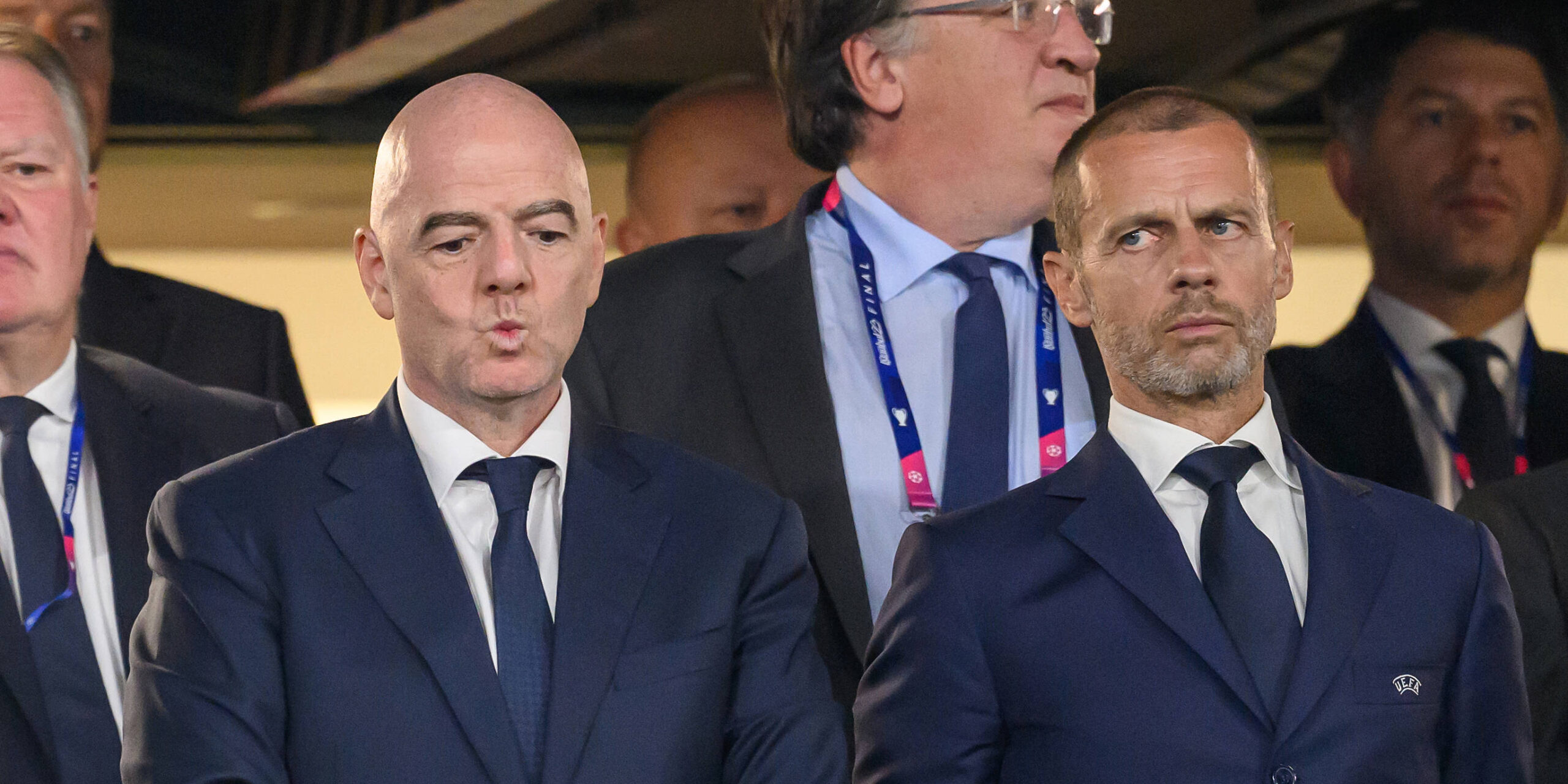
The political battle at the top of world football has entered a new and increasingly hostile phase. UEFA president Aleksander Čeferin is leading the resistance against Gianni Infantino, while FIFA has accused European football’s governing body of attempting to damage its leadership through a coordinated campaign.
The dispute centres on the abandoned FIFA Forward Enterprise project, which would have placed FIFA’s commercial and tournament operations inside a new subsidiary and opened part of that company to private investors. UEFA helped stop the proposal, but its opposition did not end when Infantino withdrew the plan at the beginning of August.
FIFA has now responded in unusually aggressive terms. According to The Associated Press, the organisation accused UEFA of running a “smear campaign” through legal proceedings in the United States designed to obtain documents connected to the failed investment project.
FIFA’s lawyers argue that UEFA is trying to protect European football’s commercial dominance and prevent smaller football nations from receiving additional investment. UEFA sees the affair very differently, viewing the proposal as a dangerous attempt to place parts of the World Cup and FIFA’s commercial future in the hands of outside investors.
Read also: Javier Tebas breaks silence on what should happen to Man City next
Čeferin compares the plan to the Super League
Čeferin has now made it clear that he considers Infantino’s proposal an even greater danger than the European Super League project defeated in 2021. That comparison is significant because stopping the breakaway league became one of the defining moments of the UEFA president’s time in office.
In an interview quoted by Reuters, Čeferin said the FIFA project was “even worse than the Super League plan”. His reasoning was that the Super League involved a group of powerful clubs attempting to create their own competition, while Infantino’s proposal risked something even more fundamental.
“Football would be literally sold,” Čeferin warned.
The statement places the UEFA president at the front of a wider revolt that extends beyond Europe. UEFA, the Asian Football Confederation and Concacaf all opposed the project, while several national associations have demanded a more extensive investigation into how it was developed and who would have benefited.
Read also: Messi admitted he targeted one World Cup rival on purpose
Billions were at stake
FIFA presented the project as a way of reducing the financial gap between wealthy football nations and smaller associations. Under the proposal, FIFA Forward Enterprise would have consolidated commercial rights connected to broadcasting, sponsorship, licensing, ticketing and tournament operations.
According to FIFA’s original announcement, the new subsidiary would have attempted to raise as much as $4.2 billion from minority investors, based on an initial valuation of approximately $20 billion. FIFA insisted that it would retain control over the company and all sporting decisions.
The money was intended to increase development funding substantially. Each of FIFA’s 211 member associations could have received access to an additional $20 million for special projects, while regular funding for the 2027 to 2030 cycle was set to rise from $8 million to $20 million per association.
Infantino therefore argues that his opponents are preventing poorer nations from receiving resources needed for stadiums, training centres, youth football and women’s competitions. His response has been to present the conflict as a fight between wealthy European football and the rest of the world.
Read also: Cristiano Ronaldo crisis forces Portugal chief into emergency action
Čeferin rejects that explanation. He pointed out that opposition within UEFA did not come only from powerful associations such as England and Germany. Smaller nations including San Marino, Cyprus and Liechtenstein also objected, despite standing to receive money equivalent to a large part of their annual budgets. Their message, according to the UEFA president, was simple: “We’re not for sale.”
Infantino could face a challenger
The dispute is no longer limited to the abandoned investment proposal. Attention has turned towards FIFA’s presidential election in March 2027, where Infantino had previously appeared likely to secure another term without facing a serious opponent.
Čeferin believes that is no longer certain. He said Infantino must either recognise that he has lost the political support of football’s wider community or enter the election against a challenger. No opposition candidate has yet been officially identified, although Concacaf president Victor Montagliani has been mentioned as a possible figure capable of building support across several confederations.
Čeferin has ruled out running for the FIFA presidency himself. He said remaining outside the contest strengthens his position as a critic because his opposition cannot easily be dismissed as a personal attempt to replace Infantino. “My credibility is much, much, much higher if I’m not interested in the position,” he explained.
Read also: Harry Kane breaks silence on Man City verdict
That decision also leaves Čeferin free to act as the organiser of the opposition rather than its candidate. UEFA controls 55 votes at the FIFA Congress, but removing Infantino would require a broader coalition among the organisation’s 211 member associations. Support from Concacaf and the Asian confederation could therefore become decisive.
European opposition is spreading
The revolt has already moved beyond UEFA’s headquarters. Six Nordic football associations, including Denmark, Norway, Sweden, Finland, Iceland and the Faroe Islands, have publicly declared that they have lost confidence in Infantino and hold serious concerns about governance and decision-making inside FIFA.
As The Guardian described, the Nordic associations demanded binding guarantees that FIFA would never again open its competitions or governance structure to private ownership. They also requested a full independent review of the FIFA Forward Enterprise project.
Norway had already gone further by directly calling for Infantino to resign. UEFA has also kept open the possibility of boycotting FIFA competitions if a similar commercial plan is revived, although such a step would carry enormous sporting and financial consequences for national teams, clubs, players and supporters.
Read also: Phil Taylor comes out of retirement for stunning darts return
For now, the threat acts as political pressure rather than a confirmed course of action. Nevertheless, the fact that UEFA is even discussing withdrawal from FIFA competitions illustrates how badly relations between the two governing bodies have deteriorated.
Trump relationship deepened the divide
Čeferin’s criticism also extends to Infantino’s close relationship with Donald Trump. The FIFA president became one of Trump’s most visible sporting allies before and during the World Cup, but Čeferin has suggested that relying on political friendships can become dangerous when the interests of football and government begin to overlap.
The UEFA president said he had not been consulted about FIFA’s decision to create a peace prize and present it to Trump. He was also highly critical after the American president said he had personally contacted Infantino about the suspension of United States striker Folarin Balogun during the World Cup.
Čeferin described political involvement in a disciplinary matter as deeply damaging because football’s rules are supposed to be applied independently. He also warned that any sporting official who believes a powerful politician is a permanent friend is being naive, since political loyalty can disappear the moment that relationship becomes inconvenient.
A battle for control of world football
Infantino still possesses significant support, particularly among associations that have benefited from FIFA development programmes. He has held the presidency since 2016 and built a political network across Africa, South America and many smaller football nations that cannot be dismissed simply because UEFA has turned against him.
However, Čeferin’s intervention has changed the nature of the contest. The UEFA president is no longer merely objecting to one commercial proposal. He is openly questioning whether Infantino retains the trust required to lead FIFA and helping create the conditions for a rival candidate to emerge.
The deadline for candidates is November 18, leaving the opposition only a limited period in which to identify a challenger and assemble a credible majority. Until then, the fight will continue across confederation meetings, public interviews and American courtrooms.
What began as a dispute over private investment has become a struggle over who controls world football, how its money should be distributed and whether Infantino can survive the largest coordinated rebellion of his presidency.