Analysis | Updated September 28, 2026
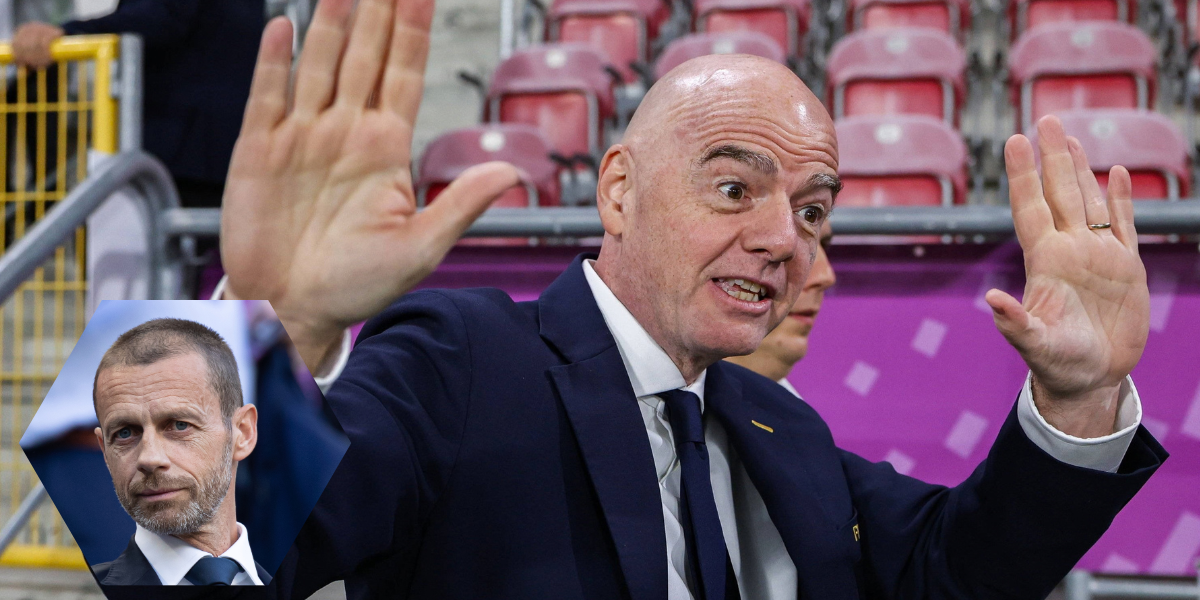
The investment proposal lasted only days in public. The confrontation it triggered is still growing. In late July, FIFA president Gianni Infantino proposed bringing outside investors into a new company that would hold commercial and event operations for FIFA competitions, including the World Cup. By August 1, the plan had been withdrawn after a threatened boycott by UEFA’s 55 national associations. By late September, UEFA was seeking evidence in four US court proceedings, three confederation leaders were pressing for a different way to fund national associations, and Infantino had offered to discuss an external review of FIFA’s governance.
The Digi24 report published on September 4 captured the first legal escalation. The story now requires two further distinctions. UEFA’s allegations are allegations, not findings of misconduct. And FIFA’s abandoned commercial transaction, the pending requests for documents in the US and a possible future criminal complaint in Switzerland are three separate stages. The timing matters to readers in North America: the plan surfaced just after the World Cup hosted by Canada, Mexico and the United States, from which Infantino expected FIFA to exceed $15 billion in revenue for the 2023–26 cycle. That figure is revenue across four years, not profit available to distribute.
The dispute reaches back beyond 2026
Infantino once had UEFA’s institutional backing. He was its general secretary when UEFA unanimously endorsed his FIFA presidential candidacy in October 2015, explicitly presenting him as a reform candidate. The commercial fault line appeared more clearly in 2018, when he advanced an investor proposal of around $25 billion over 12 years for an expanded Club World Cup and a proposed global Nations League. The structure envisaged a company owned 51% by FIFA and 49% by investors. European resistance helped stop that particular arrangement. It was a different proposal from the one withdrawn this summer, but the recurring argument is recognizable: who may put football competitions into an investment vehicle, and who gets to decide?
Read also: Manchester City’s biggest problem may not be the charges everyone thinks
According to UEFA’s August 27 court application, the origins of the 2026 project can be traced to discussions between investor Joshua Kushner and former Liberty Media chief Greg Maffei in July 2025. This reconstruction relies in part on earlier reporting and is UEFA’s account of events, not a judicial finding. FIFA later publicly identified Kushner-controlled Thrive Eternal as the expected lead investor, Maffei as a commercial adviser and J.P. Morgan as a bank engaged on the project.
What FIFA proposed on July 28
FIFA’s July 28 announcement described FIFA Forward Enterprise, or FFE, as a FIFA-controlled subsidiary combining commercial rights and tournament operations. Broadcast, sponsorship, ticketing and licensing would be part of the business. Outside investors were expected to contribute up to $4.2 billion for a minority, non-controlling interest, based on an initial valuation of approximately $20 billion. In practical terms, that is roughly one-fifth of the proposed company’s economic value, not a sale of FIFA itself or a formal transfer of sporting rule-making powers.
The distinction matters, but it did not resolve UEFA’s objection. FIFA said it would keep majority board control and exclusive authority over competitions, governance and the match calendar. UEFA argued that permanent investors in the company earning money from those competitions would still have a financial interest in decisions affecting formats, scheduling and future revenue. Whether such influence would have arisen under a final agreement cannot be established: the deal never reached that stage.
The sums offered to members also need to be kept separate. FIFA said its regular Forward allocation could rise from $8 million per association for 2023–26 to $20 million for 2027–30 if FFE went ahead. It proposed an additional, voluntary, one-off Fast Forward facility of up to $20 million per association, financed through the outside investment. That is the basis of the possible $40 million figure. The extra $20 million was conditional on the project; it was not a payment that 211 associations had already received. If every association drew the maximum one-off amount, the arithmetic would be $4.22 billion, approximately the entire planned $4.2 billion capital raise.
Read also: Christian Horner wants Ferrari move – Fred Vasseur’s response says it all
Why the approval process caused a revolt
UEFA says the transaction had been developed without meaningful prior scrutiny by FIFA’s elected Council or member associations. In its court filing, citing reporting about a July 18 meeting at New York’s Waldorf Astoria, it says five senior managers were presented with the proposal shortly before the World Cup final and that three supported it while two opposed it. Those details form part of UEFA’s case and should not be mistaken for facts established by a court. They explain why opponents focused as much on process as on price.
FIFA’s public position was different: Infantino said on July 30 that FFE was still a proposal and would require majority support from the 211 member associations and approval from the FIFA Council. FIFA called the consultation an opportunity rather than an obligation. UEFA objected that associations were being asked to consider a permanent commercial change on a compressed timetable, while a one-off payment was tied to support for the scheme. FIFA subsequently said media reporting had disrupted the planned consultation. No final vote by the full membership or Council approved FFE.
The split became public almost immediately. UEFA’s first statement on July 28 said FIFA had crossed a line. On July 30, UEFA and its 55 associations threatened to withhold their national teams from FIFA competitions while the proposal remained alive and until they received binding assurances. That was a political threat with obvious sporting consequences, not a boycott that went ahead.
The opposition was not confined to Europe. On July 31, Infantino’s senior adviser Carlos Cordeiro resigned over the plan. Later that day, Infantino announced that the proposal would not proceed, saying the divisions it had caused defeated its purpose. UEFA welcomed the withdrawal on August 1 but immediately demanded an inquiry into how the plan had been prepared. At an August 5 management meeting, FIFA acknowledged errors in its handling and communication, apologized to members, and maintained that it had complied with its rules. In an August 10 joint letter, the leaders of UEFA, Concacaf and the Asian Football Confederation argued that the problem went beyond poor communication.
Read also: Lewis Hamilton’s Ferrari frustration boils over after Baku
The legal fight is about evidence before any Swiss case
UEFA’s delegates went further on August 27. They called for an independent inquiry and a possible alternative to Infantino in the 2027 election. They also said FIFA had given a written assurance that FFE was permanently withdrawn and provisionally suspended their threatened non-participation in FIFA competitions. On the same date, UEFA began seeking documents and testimony from US-based companies and individuals under a law that can allow evidence gathering for foreign proceedings. A fourth application followed on August 28.
The four applications are directed at different potential sources: two FIFA entities in Florida; Kushner and Thrive Capital in New York; Maffei and BANN Ventures in Colorado; and J.P. Morgan entities and two executives in a second New York case. UEFA wants to investigate the project’s origins, internal approvals, valuation and communications with investors. It says the material could be used in a contemplated Swiss complaint concerning criminal mismanagement under Article 158 of the Swiss Criminal Code. The US applications request access to evidence. They are not criminal charges against Infantino, and a court granting document discovery would not decide whether the alleged Swiss offence occurred.
UEFA alleges that the approximately $20 billion valuation was not tested through an open auction or independent assessment. It also raises potential conflicts of interest and questions the coupling of investment proceeds with promised payments to the associations voting on the plan. FIFA disputes the characterization. In a September 1 US court filing, its American subsidiaries described UEFA’s filings as a smear campaign, argued that no Swiss criminal proceeding had yet been opened and sought a chance to oppose or delay the document requests. They also alleged that UEFA had an economic interest in limiting competition from smaller football nations. That is FIFA’s argument, not an established explanation for UEFA’s actions.
There has been procedural movement, but no verdict on the central allegations. On September 21, a New York judge refused to pause the J.P. Morgan discovery case while the Florida court considers a separate request. That narrow ruling did not grant UEFA the records or validate its accusations. The public case record reviewed for this article contains no finding that Infantino committed wrongdoing and no confirmed Swiss criminal charge as of September 28.
Read also: Bad news for Roberto Carlos
The next argument is over FIFA’s own money
The financial counterproposal arrived on September 18. UEFA president Aleksander Čeferin and Concacaf president Victor Montagliani asked FIFA to make at least $10 million available to each of its 211 members during 2027–30: $2.11 billion in total, on top of the existing Forward programme. They argued that FIFA could pay from reserves without selling a stake in its competitions, and requested an independent examination of the finances. The AFC president subsequently supported a review of the reserve position.
Here the dates behind the numbers are essential. Their roughly $6 billion reserve figure is an estimate for the end of the 2023–26 World Cup cycle, not the last audited balance. FIFA’s 2025 financial report records $2.699 billion in reserves at December 31, 2025. It also records $6.948 billion in cash and financial assets, but much of the money already received before the 2026 World Cup had matching obligations on the liabilities side. Cash in the bank is therefore not interchangeable with freely distributable reserves. The proposed $2.11 billion payment is a political and financial proposal, not an approved distribution, and its affordability depends on the completed 2026 accounts and FIFA’s future commitments.
The October meeting will test what has really changed
On September 21, Infantino told the 211 associations he would ask the FIFA Council whether it wanted an independent external review of governance for major initiatives and a structured consultation on how decisions are made, according to the letter seen by the Guardian. The proposal leaves a crucial issue open: it does not explicitly commit to an independent investigation of the FFE transaction itself, including the documents and individuals UEFA wants examined. FIFA’s Council is expected to address the matter on October 15.
This is now a contest on three tracks. The US judges must decide whether and how much evidence UEFA may obtain; FIFA’s members must decide whether new funding should come from existing resources or a different commercial model; and the governing bodies must decide how much power the president can exercise before seeking institutional approval. The FIFA presidential election is scheduled for March 18, 2027, and Infantino has said he intends to run. UEFA has threatened to support an alternative, but that is a political position, not an election result.
Read also: Ferran Torres is doing something at PSG only Zlatan did better
The most defensible conclusion on September 28 is precise. FFE is withdrawn and the threatened European boycott is provisionally suspended. An independent review and an extra $2.11 billion distribution have been proposed, not adopted. The US evidence requests remain distinct from a Swiss prosecution. What happens next depends on court orders, the scope of any review, verified year-end finances and decisions by the associations that FIFA exists to serve.