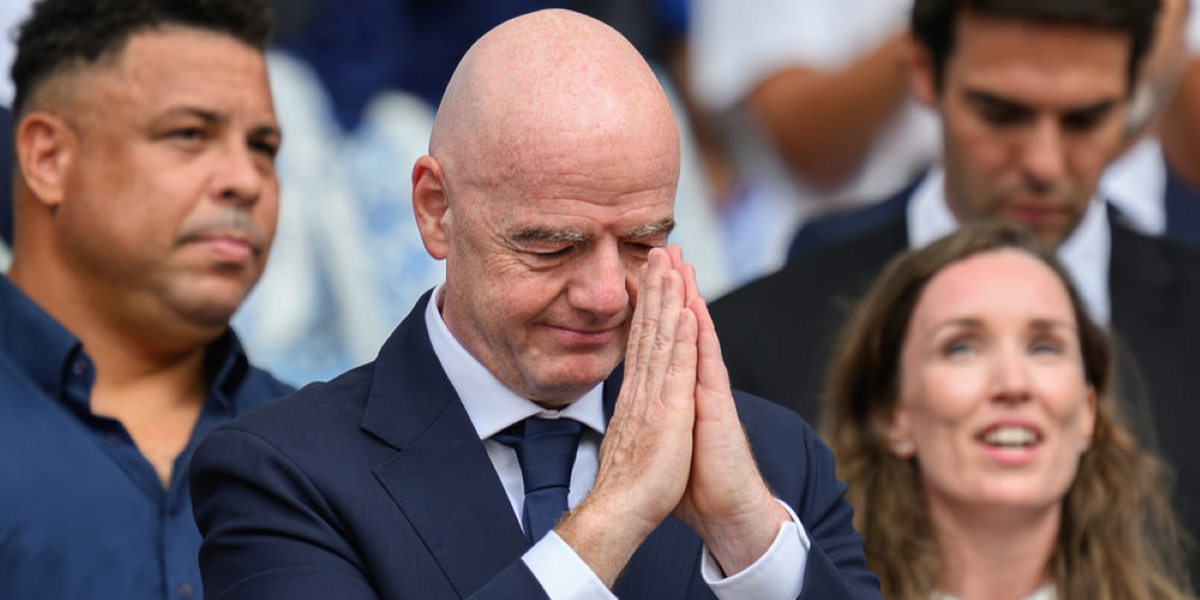
Gianni Infantino is facing the most serious challenge to his FIFA presidency since taking office in 2016. The crisis was triggered by FIFA Forward Enterprise, a proposed commercial company that would have allowed private investors to acquire an interest in FIFA competitions, including the World Cup. Although the project has now been abandoned, the political revolt against Infantino continues to grow.
FIFA confirmed on 31 July that the proposal would not proceed after opposition spread across several confederations. The withdrawal brought an immediate end to the commercial plan, but not to the questions surrounding the way it was developed. European officials are now discussing whether Infantino should remain in office or be challenged before the 2027 presidential election.
A commercial plan triggers a global revolt
FIFA Forward Enterprise was intended to oversee commercial and operational elements of FIFA’s leading competitions. The most controversial part of the proposal involved selling a minority stake in the new company to private investors. Critics argued that this would give external shareholders a permanent financial interest in decisions affecting the World Cup.
UEFA’s 55 member associations unanimously rejected the project and threatened to boycott FIFA competitions for as long as the proposal remained alive. According to UEFA’s official statement, the organisation considered the plan a serious failure of leadership and declared: “The World Cup is not for sale.” The proposed boycott placed enormous pressure on FIFA because it would have removed every European national team from future tournaments.
Read also: UEFA warns Infantino, threatens legal action over failed World Cup plan
Infantino eventually backed down after UEFA was joined in opposition by CONCACAF and the Asian Football Confederation. According to FIFA’s statement announcing the withdrawal, the project had created divisions that were no longer compatible with its original purpose. Infantino concluded: “As a result, this proposal will not proceed.”
UEFA declares that confidence has gone
With the proposal withdrawn, UEFA immediately turned its attention to the people responsible for developing it. According to UEFA’s response to FIFA’s retreat, the organisation will work with national associations and other confederations to establish how the plan reached such an advanced stage. It added: “The current FIFA leadership has not only lost UEFA’s confidence but also that of many other members of the football family.”
That statement represents a major political break with Infantino, but it is not itself a formal dismissal or no-confidence motion. UEFA did not explicitly order him to resign in its public statement, even though reports have described its position as an ultimatum. The federation instead said that no option should be excluded from the review of FIFA’s leadership and governance.
CONCACAF demands a reckoning
The pressure is no longer confined to Europe. CONCACAF, which represents 41 associations across North America, Central America and the Caribbean, accused FIFA of advancing the proposal without adequate transparency, consultation or due process. The confederation argued that a project of such magnitude could not have reached that stage by accident.
Read also: Doornbos tips Verstappen to end contract standoff at Zandvoort's last Dutch GP
According to CONCACAF’s official statement, the episode was evidence of leadership that had stopped placing football first. The organisation declared: “A comprehensive reckoning with this presidency is imperative.” Its intervention is particularly damaging because the United States, Canada and Mexico had just staged the 2026 World Cup.
Previous ethics claims require important context
The latest crisis has revived criticism of FIFA’s internal ethics system, including allegations made during Infantino’s first year as president. Reports at the time referred to private flights and expenses involving items such as mattresses, football boots and exercise equipment. However, any account of that episode must also include the outcome of the investigation.
According to FIFA’s Ethics Committee decision from August 2016, investigators found that Infantino had not violated the organisation’s Code of Ethics. Allegations concerning expenses and governance did not produce a prima facie ethics case, while questions involving recruitment and Infantino’s employment contract were classified as internal compliance matters. Infantino was therefore cleared in that investigation.
FIFA replaced ethics officials Cornel Borbély and Hans-Joachim Eckert in May 2017 after the FIFA Council proposed new chairmen and the Congress approved the changes. As described by an Associated Press report published by Sports Illustrated, Borbély said that several hundred cases were still pending and called his removal politically motivated. The process drew considerable criticism, but it is inaccurate to state that Infantino personally fired the investigators immediately after they opened a case against him, as the previous inquiry had concluded nine months earlier.
Read also: The bullying story behind Gianni Infantino’s rise to FIFA
How Infantino could be removed
FIFA’s statutes allow member associations to force an extraordinary Congress. Under Article 25, the Council must convene one if a fifth of FIFA’s members submit a written request containing the proposed agenda. With 211 associations, that threshold is 43, and an extraordinary Congress must then be held within three months.
The Congress has the authority to dismiss the FIFA president. According to FIFA’s published statutes, a simple majority of valid votes cast would be required unless another provision applied. The figure would only be 106 if all 211 associations participated and cast valid votes, so it should not be presented as an automatic fixed threshold.
UEFA has enough members to force an extraordinary Congress if at least 43 of its 55 national associations submit the necessary written request. That has not yet happened, and no formal vote on Infantino’s dismissal has been announced. Political pressure alone cannot remove him without either his resignation or the statutory process being activated.
Denmark withdraws its support
Denmark has joined the opposition through DBU chairman Jesper Møller. As quoted by DBU’s official statement, Møller said: “I fully agree that confidence in the FIFA president has disappeared. Therefore, I cannot support him, just as we did not in 2023.” He also confirmed that DBU would support the process now being discussed within UEFA and among the Nordic associations.
Read also: Infantino scrapped his World Cup stake plan: Britain’s prime minister still wants him out
Infantino has announced that he intends to seek another term at the FIFA Congress in Rabat on 18 March 2027. More than 200 associations had reportedly submitted letters endorsing him before the latest crisis, although those declarations are not votes and can be withdrawn. According to The Guardian reporters Nick Ames and Matt Hughes, European associations are now discussing a coordinated withdrawal of their support.
No official challenger has entered the presidential contest, and Infantino continues to receive backing from important associations outside Europe. His removal is therefore neither certain nor imminent. What has changed is that a presidency previously heading towards an uncontested election now faces an organised international campaign to bring it to an end.
Read also: Pogacar won the Tour de France last week. Now he has been beaten by seven amateurs in his own race