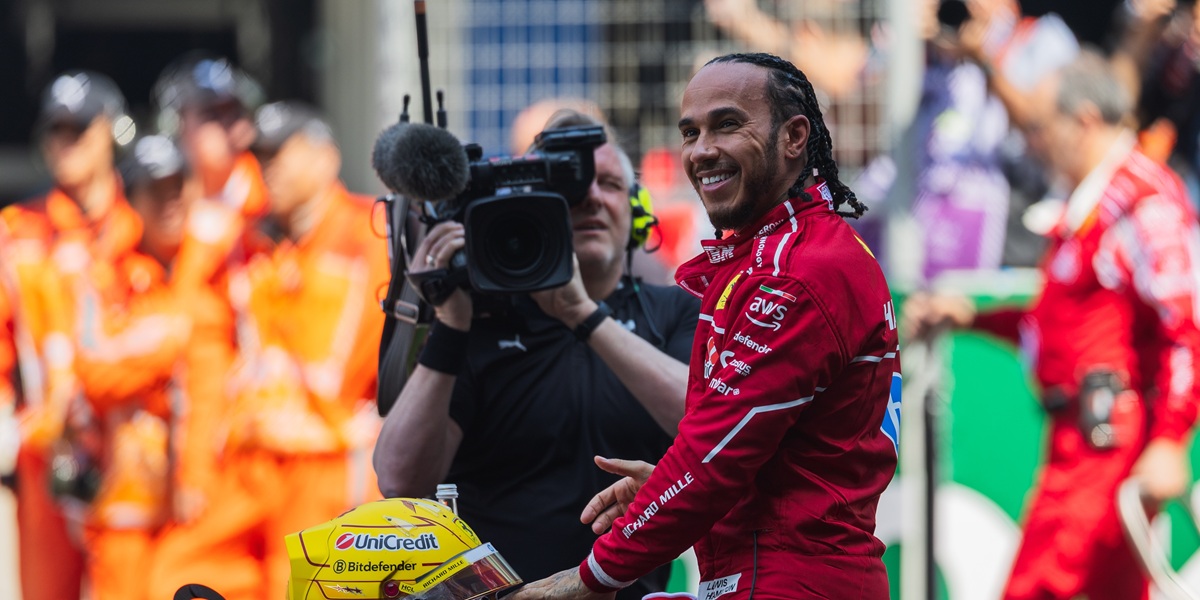
“If we had the same power as them, we would be right there in the battle. I think we’d probably be on the front row,” Lewis Hamilton told Formula1.com after qualifying fifth for the United States Grand Prix on Saturday.
It was the Ferrari driver’s own one-line verdict on a season that has slipped out of Maranello’s hands. Pole went to Antonelli in 1:34.035, with Max Verstappen alongside him. Charles Leclerc qualified fourth in 1:34.267, just over two tenths off pole, with Hamilton a place further back, according to the official timing.
The gap was not in the corners. Hamilton told Formula1.com that the deficit lived in one place: the straights.
“We know through the weekend we look at the straight, like just up to Turn 1, when we cut power, they just keep pulling,” he said after qualifying.
Read also: Thomas Tuchel makes surprise Ballon d’Or admission just hours before winner is crowned
He put a number on it, estimating the straight-line deficit at around three-tenths earlier in the day, stretching to three to five tenths in places. The-Race’s Josh Suttill, reviewing the data, noted the straight-line deficit was consistent across all three qualifying stages, not a Q3 anomaly, and that Hamilton trailed Antonelli by around 10 km/h at the end of the back straight.
The super-clipping trap
The mechanism behind the deficit is specific to the 2026 power unit rules. With the electrical component carrying close to half the total output, teams that cannot keep the battery topped up run into “super clipping”: once the deployable energy is spent on a straight, the MGU-K switches to generator mode and starts recharging by taking power out of the internal combustion engine. Acceleration flattens off while the opposition is still pulling.
Ferrari’s drivers have been running into that wall all season. “Into Turn 1, ours starts dipping and theirs just keeps going,” Hamilton told The Race, describing the exact moment the SF-26 falls off compared to Verstappen’s Red Bull.
Team principal Frederic Vasseur has already named the problem. “At the end, we are missing pure power,” he told F1i.com at Monza. “If you are missing X in Zandvoort, you are two or three tenths down. If you are missing a bit less than X in Monza, the delta with the Merc is two times bigger.”
Read also: Liverpool make official decision on Brighton clash as storm threatens Premier League fixture
Why Austin was always going to hurt
Ferrari brought one of the largest upgrade packages on the grid to Austin, a redesigned floor stretching from the leading edge to the diffuser, according to The Race. The gain showed up in cornering balance, not in top speed. The chassis is no longer the problem.
Hamilton has been direct about where the strength now sits.
“They have closed up on chassis, but we’re not able to take that step in this season to close that speed on the straight,” he told The Race.
A circuit with the long back straight and uphill run to Turn 1 at COTA punishes exactly the weakness Vasseur has conceded is structural. More downforce helped Leclerc and Hamilton through sector two but could not change what happens when the throttle is pinned.
Read also: ‘He was playing rugby’: Unai Emery makes remarkable claim about Aston Villa match-winner
2027 is the reset
Vasseur has already pointed the fix past this calendar. The ADUO regulation granted Ferrari a second in-season engine development opportunity, deployed at Monza, but Vasseur has said that was never meant to close the gap in 2026.
“We were not expecting to recover with ADUO 1 or ADUO 2. We are doing small steps,” he told Grandepremio. “That means that now we will have a new engine next year. For sure, the target is to catch up, to catch up as soon as possible.”
Antonelli, 102 points clear of George Russell in the standings, needs to win on Sunday with Russell outside the top eight and Hamilton outside the top four to clinch the title in Texas, per the Associated Press. The race starts at 3pm local time at the Circuit of the Americas.
Read also: Indianapolis Colts break silence after Anthony Richardson faces criminal charge