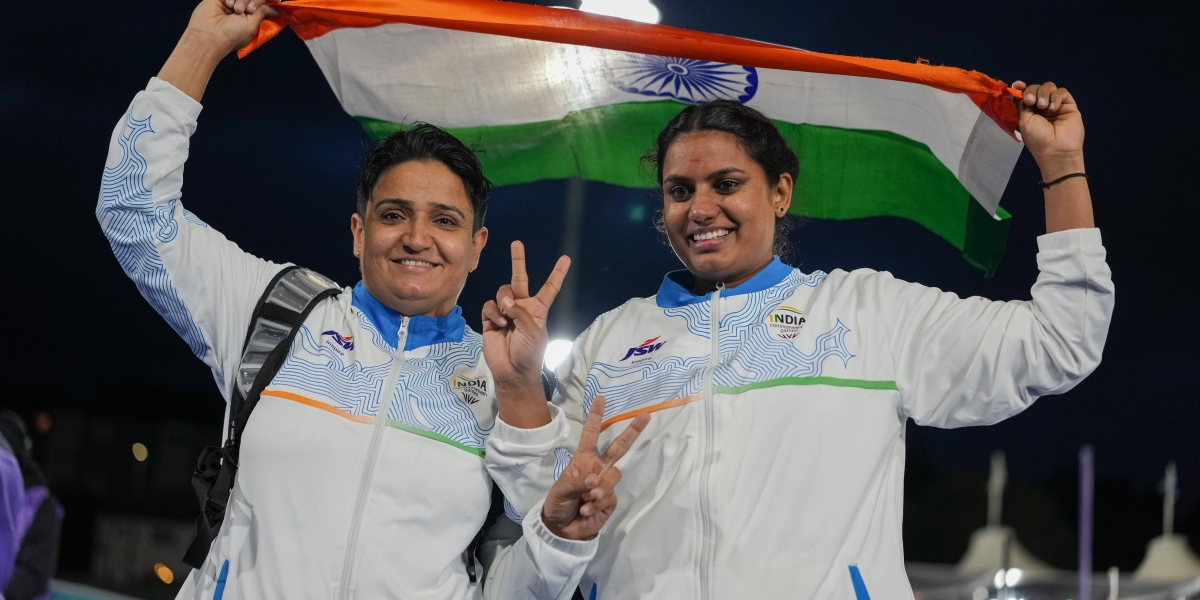
Sharmila Dhankar’s winning throw travelled 9.81 metres. The journey behind it had taken almost four decades.
The Indian athlete won the women’s shot put F57 final at the Commonwealth Games in Glasgow, producing a season-best performance and ending India’s 20-year wait for a para-athletics medal at the Games.
Her victory also made her the first Indian athlete to win Commonwealth para-athletics gold. Yet the medal only tells a small part of a story shaped by disability, poverty, domestic violence and a sporting career that began at an age when many athletes are already preparing to retire.
Her life changed when she was two
Dhankar contracted polio after suffering a high fever at the age of two. The illness affected her left leg, but she remained one of the strongest pupils in her school and repeatedly finished near the top of her class.
Read also: ‘I’m not confident’: Red Bull chief delivers troubling verdict on Verstappen’s car
Her family could not afford to continue supporting her education. She was married at 19 and moved into a relationship that, according to her own account, became increasingly violent after the birth of her second daughter.
As described by Nitin Sharma in The Indian Express’ detailed account of her life, Dhankar says her first husband eventually stripped her and forced her and her two young daughters from their home in 2012. Neighbours covered her with a quilt before her parents arrived to take the family away.
Fourteen years later, she stood on top of a Commonwealth Games podium in Scotland.
Her mother refused to leave her behind
Dhankar returned to her parents’ village with her daughters. The separation did not immediately end the pressure, as relatives reportedly accused her of destroying her own marriage.
Read also: Man City hit back at Premier League with explosive accusation
Her mother, Santosh, had been blind since birth but insisted that her daughter should not be sent back into the abusive relationship. The family supported Dhankar through a divorce that was completed several years later.
According to The Indian Express, Santosh later sold part of the family’s farmland when money was needed for training. Dhankar’s father died one year before the Glasgow Games, leaving her mother to continue supporting the sporting ambition they had built together.
After winning gold, Dhankar called her mother, her daughters and her second husband, Ajit Singh. The medal belonged to an entire family that had refused to allow the worst moment of her life to define the rest of it.
Sport entered her life in her thirties
Dhankar remarried in 2018. Ajit, a technician, encouraged her to try sport and initially introduced her to kabaddi before taking her to a stadium in Rewari.
Read also: Manchester City CEO says everything is one big “conspiracy theory”
She eventually began training in para-athletics under Paralympian Tek Chand. Dhankar says she only started competing at approximately 33, making her rise unusually rapid even within a sport known for athletes discovering new opportunities later in life.
Ajit left his job and took out loans to finance the training of Dhankar and her daughters. Her mother sold land, while the family committed itself to a dream that offered no guarantee of financial return or international success.
Within a year, Dhankar had become a national champion. She later represented India at the Birmingham Commonwealth Games, where she came close to the podium, and established herself in both shot put and discus.
Glasgow delivered India’s historic breakthrough
Dhankar arrived in Scotland after winning shot put gold and discus bronze at the Fazza International Para Athletics Championship. Glasgow featured the largest para-athletics programme in Commonwealth Games history, with 16 medal events integrated into the athletics schedule.
Read also: Pogacar’s home Euros go on without him, and now without Van der Poel too
Her 9.81-metre throw was enough to win the F57 final. The classification is used for athletes with lower-limb impairments who compete from a seated throwing frame.
India’s success became even greater when teammate Shilpa K. Shyla was promoted to bronze following an official protest. Nigeria’s Eucharia Iyiazi had initially occupied third place, but a review determined that her only valid-looking attempt should have been recorded as a foul.
Dhankar and Shyla therefore celebrated a historic Indian double podium at Scotstoun Stadium.
The medal carried a message beyond sport
Moments after winning, Dhankar used the attention to address other women facing violence. Her message was that women and girls should fight back against abuse rather than accept it as their fate.
Read also: Laporta on Man City verdict: Barcelona president breaks silence on football’s biggest scandal
The statement mattered because her victory did not transform the past into something positive. The abuse remained abuse, and the years she lost could not be restored by a medal.
Gold instead demonstrated what became possible after she was given safety, support and the freedom to develop her own ambitions.
Indian Prime Minister Narendra Modi described the performance as a historic achievement and highlighted that it had ended a two-decade wait for Commonwealth para-athletics gold.
Her final dream involves her daughters
Dhankar is not planning to stop at 40. Her coach believes she may be capable of competing for another four or five years because of the intensity and consistency of her training.
The athlete has identified the Asian Games as her next major target. She also carries a more personal ambition.
Both of her daughters have entered athletics. Anuj competes in javelin, while Laxmi has pursued the long jump.
Dhankar now dreams of qualifying for a major Games alongside them. The woman once forced into the street with her two children wants the three of them to return together as athletes.