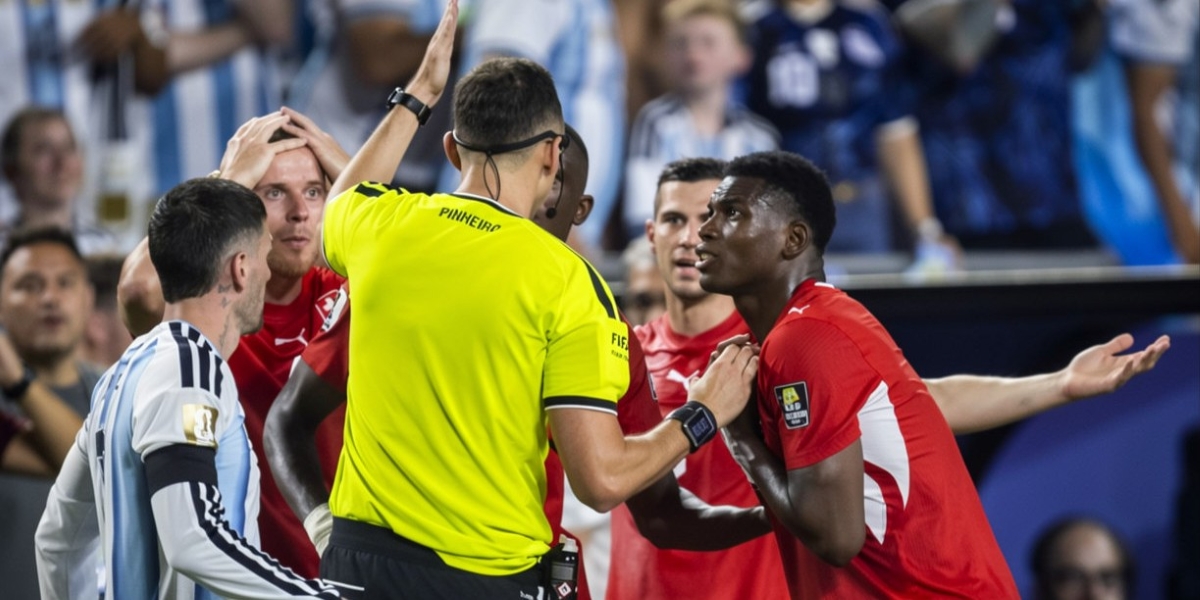
Switzerland’s World Cup campaign ended amid anger and confusion after Breel Embolo was sent off during their 3-1 quarter-final defeat by Argentina.
The forward received a second yellow card for simulation in the 72nd minute, only five minutes after Dan Ndoye had drawn Switzerland level. Embolo left the pitch in tears, while his teammates and coaching staff reacted furiously to the VAR intervention.
According to UNILAD’s account of the incident, Embolo became the first player at the tournament to be dismissed as a direct result of the newly expanded “mistaken identity” provision. He was not, however, the first player affected by the rule during the World Cup.
How the incident unfolded
Argentina midfielder Leandro Paredes initially appeared to catch Embolo as the Swiss forward moved through midfield.
Read also: Harry Kane’s Bayern future suddenly comes with a Tottenham escape route
Portuguese referee João Pinheiro stopped play and showed Paredes a yellow card for what he believed was a reckless challenge. The decision appeared routine until video assistant referee Guillermo Pacheco Larios recommended an on-field review.
Replays showed that Embolo had begun falling before meaningful contact was made. Pinheiro consequently removed Paredes’ yellow card and instead cautioned Embolo for simulation.
Because the Switzerland forward had already been booked for a first-half foul on Paredes, the decision resulted in a second yellow card and his dismissal.
As described by Alexander Abnos in The Guardian, Switzerland had begun to take control after their equaliser, only to be reduced to ten men moments later.
Read also: ‘I’m not confident’: Red Bull chief delivers troubling verdict on Verstappen’s car
Argentina were unable to break down the depleted Swiss side before the end of normal time, but Julián Álvarez and Lautaro Martínez scored during extra time to secure a 3-1 victory and a semi-final against England. Alexis Mac Allister had earlier given Argentina the lead before Ndoye equalised.
What the mistaken identity rule actually means
The description of the regulation as an entirely new “mistaken identity rule” is slightly misleading.
VAR has long been allowed to intervene when a referee cautions or sends off the wrong player. Traditionally, this applied when two players from the same team were confused, such as when a referee booked a defender despite a teammate having committed the foul.
The scope of the rule was expanded for the 2026–27 Laws of the Game. According to the IFAB’s official explanation of the changes, VAR can now intervene when the player punished is from the wrong team, provided another player committed the offence for which the card was shown.
Read also: Man City hit back at Premier League with explosive accusation
The crucial amendment removed the previous requirement that the correct offender had to belong to the team originally penalised.
That allowed VAR to conclude that Paredes had not fouled Embolo and that the punishable offence was instead simulation by the Swiss forward.
The change does not permit VAR to examine any ordinary yellow-card decision. The intervention must concern mistaken identity or a clearly incorrect second caution that produces a red card.
The rule had already been used at the tournament
Embolo’s dismissal was the most significant application of the amended regulation, but it was not the first time officials had used it at the World Cup.
Read also: Manchester City CEO says everything is one big “conspiracy theory”
During the United States’ group match against Paraguay, American defender Tim Ream was initially booked for an apparent foul on Miguel Almirón.
After a VAR review, the referee decided that Almirón had simulated the contact. Ream’s caution was cancelled and the Paraguayan forward was booked instead.
That incident did not result in a sending-off because Almirón had not previously received a yellow card. In Embolo’s case, the same process produced far greater consequences because he was already on a caution.
It is therefore more accurate to describe Embolo as the first player dismissed at this World Cup through the expanded application of mistaken identity, rather than the first footballer ever punished under any mistaken identity rule.
Read also: Pogacar’s home Euros go on without him, and now without Van der Poel too
Yakin condemns decisive intervention
Switzerland coach Murat Yakin accepted that the incident appeared harmless but strongly disputed the need for VAR to become involved.
“This rule destroyed the game today,” he said after the defeat.
Yakin argued that the original challenge did not warrant a yellow card for either player and believed play should simply have continued.
“There was definitely no reason to award a yellow card,” he said. “It was a harmless situation.”
Midfielder Remo Freuler was equally critical, describing the decision as “a disaster” and questioning why VAR had intervened in an incident that would ordinarily have attracted little attention.
Their anger centred less on whether Embolo went down easily and more on the scale of the punishment created by the review. A relatively minor midfield incident ultimately left Switzerland playing with ten men for the remainder of normal time and all of extra time.
A legal decision that still divides opinion
Under the amended IFAB protocol, the officials were entitled to review the incident.
The footage allowed them to decide that the initial card had been given to the wrong player from the wrong team. Once Pinheiro judged Embolo guilty of simulation, he was required to show a yellow card, which automatically became a red because of the forward’s earlier caution.
That does not mean the decision was beyond debate.
Simulation remains a subjective judgement, particularly when some contact occurs after a player has begun to fall. Critics have also questioned whether VAR should become involved in relatively minor incidents when the result can have such a decisive effect on a match.
For Switzerland, the distinction between a technically correct process and a proportionate outcome offered little consolation. Embolo’s dismissal changed the balance of a World Cup quarter-final just as Yakin’s side appeared capable of troubling the defending champions.
The incident is likely to become an important test case as referees, players and supporters adjust to VAR’s expanded powers.