The sound has become familiar at this World Cup: the referee blows, the players walk to the touchline, and the crowd groans.
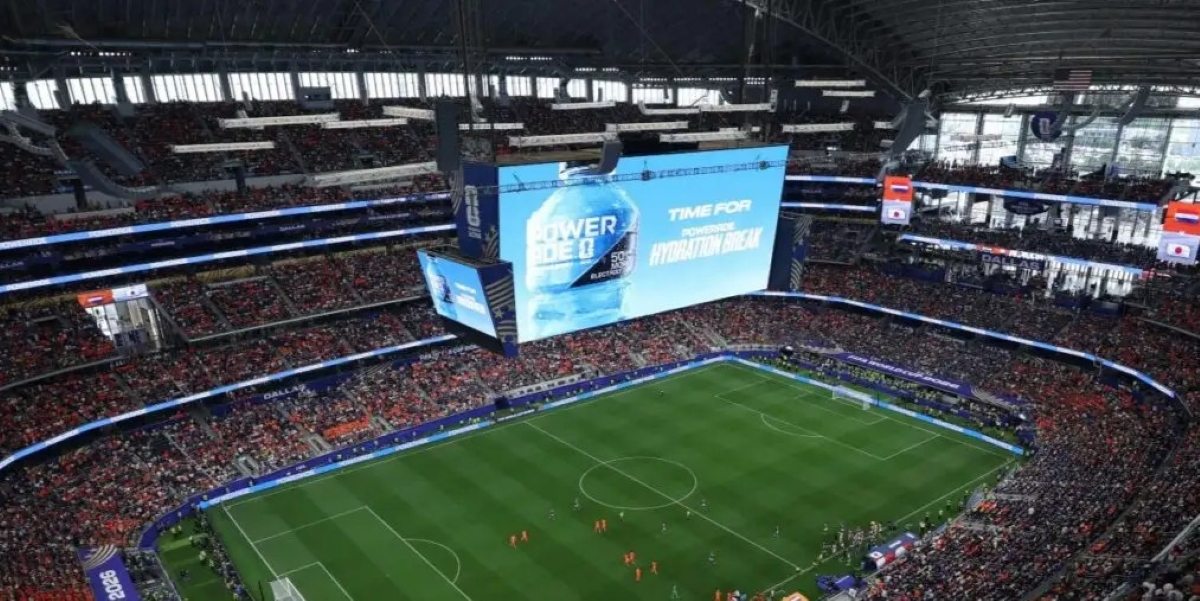
Mandatory hydration breaks were introduced by FIFA as a player-welfare measure for a tournament played across the United States, Canada and Mexico in the heat of June and July. But the pauses are increasingly being greeted with frustration in the stands and suspicion among viewers, many of whom believe the stoppages have turned football into something closer to a four-quarter television product.
The breaks last three minutes and are taken midway through each half, regardless of the weather or whether the stadium is air-conditioned. According to TV 2 Sport, the irritation has been audible at several matches, including Japan against Tunisia, the Netherlands against Sweden and Germany against Ecuador.
A welfare measure under suspicion
FIFA’s public argument is clear. The governing body says the measure is designed to give all teams the same conditions and to protect players during a tournament staged in North America’s summer heat.
Read also: Kraken bet big on Bobby McMann after breakout season
There is logic to that position. Recent tournaments in the United States have raised serious concerns about heat, humidity and player safety. Even so, the decision to apply the breaks to every match has made the rule harder to defend for some critics.
At cooler venues, or inside stadiums where conditions are controlled, the stoppages can feel less like medical caution and more like a structural change to the game.
That is where much of the anger comes from. Football has traditionally been built around two 45-minute halves. The new rhythm divides each match into four sections, giving players a break, coaches a chance to reorganise and broadcasters a rare opportunity to leave live play.
Bielsa joins the criticism
Uruguay coach Marcelo Bielsa has become one of the clearest voices against the change. Quoted by AS, Bielsa said: “Playing four periods instead of two changes the concept and culture that had been built to interpret football. This change adds nothing and takes away a lot. When it was divided into four, no thought was given to the effect it can have on what made football a sport people fall in love with.”
Read also: Panthers land Brady Tkachuk in blockbuster family reunion
His criticism captures the broader unease. The issue is not whether players should be allowed to drink water. It is whether a mandatory, television-friendly pause in every half alters the character of the sport.
That concern has also been voiced by players. Netherlands captain Virgil van Dijk told reporters that the commercial element made the breaks difficult to accept. “I think for the neutral watchers on TV, it’s also not great. So if it’s really hot, obviously it will be good to put them in. But I think you have to look at it in every game separately, in my opinion,” he said in a Reuters report published by The Star.
The advertising question
The controversy has been sharpened by what happens during the breaks on television.
Broadcasters are allowed to begin commercials 20 seconds after the referee signals the hydration break, and they must return to live coverage 30 seconds before the restart. In practice, that creates two new advertising windows in every match.
Read also: Hall of Fame decision day arrives for Bergeron, Price and a crowded ballot
For American broadcaster Fox, those windows are potentially worth a fortune. According to BBC Sport, the extra inventory could amount to eight additional 30-second advertising slots per match, or hundreds of commercial opportunities across the tournament.
That is why critics find FIFA’s explanation incomplete. Player welfare may be part of the rationale, but the breaks have also created a commercial opportunity that football has historically resisted: full advertising interruptions during live play.
Not every broadcaster cuts away
The response has varied by market. Fox has used the breaks for full-screen commercials, while Telemundo in the United States has chosen not to cut away in the same way. In Britain, ITV has also avoided using the pauses for standard ad breaks, partly because of advertising rules and partly because of the sensitivity around interrupting live football.
Those differences have exposed a cultural divide. American sports audiences are used to regular commercial stoppages. European football audiences are not.
Read also: Spurs is adding Rashford to their summer transfer list
That divide helps explain why the same pause can look normal to one viewer and deeply intrusive to another.
A pause that changes the game
The breaks have also become tactical moments. Coaches can gather players, change instructions and slow an opponent’s momentum. Some managers have welcomed that. Others believe it gives football a rhythm it was never meant to have.
That is the deeper argument now surrounding the rule. FIFA may describe the stoppages as hydration breaks, but they are also coaching breaks, advertising breaks and momentum breaks.
For players in extreme heat, they may be necessary. For fans who value football’s uninterrupted flow, they remain hard to accept.
Read also: Maresca gets first Man City test as Doku faces World Cup row
The water breaks may last only three minutes. The debate they have created is likely to last much longer.