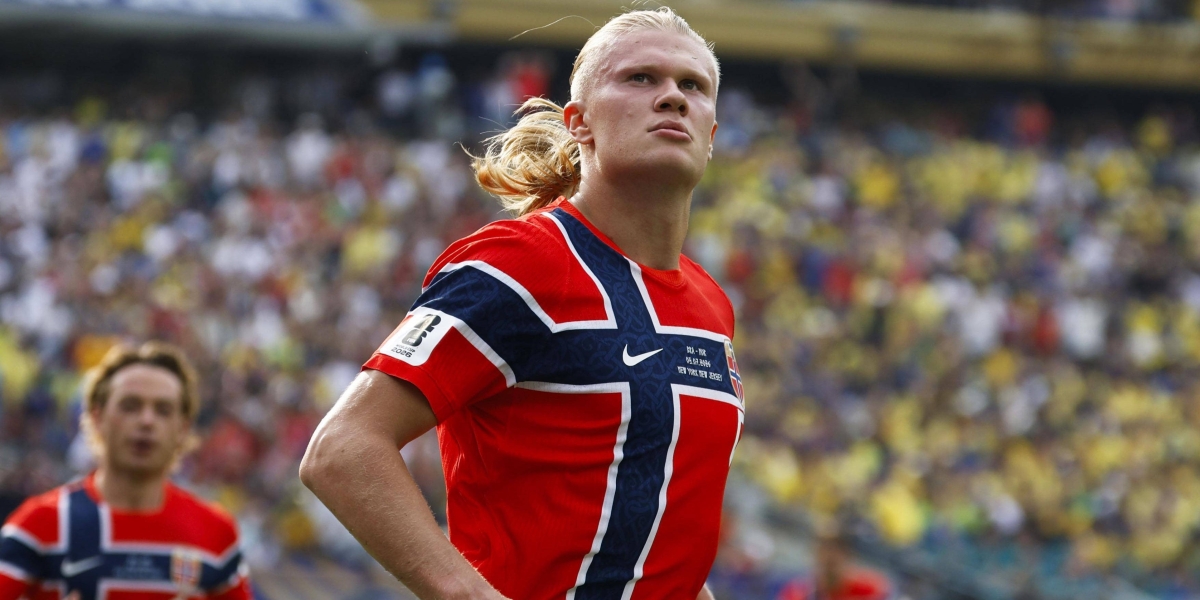
Erling Haaland left the 2026 World Cup without the trophy, but with his reputation transformed far beyond the boundaries of the football pitch.
The Manchester City striker scored seven goals in six appearances as Norway reached the quarter-finals for the first time in their history.
His tournament ended with a 2-1 extra-time defeat to England in Miami, where Haaland failed to score for his country for the first time since October 2024.
Norway’s elimination could not erase what had come before. Haaland scored twice against Iraq, added another double against Senegal and struck the winning goal against Ivory Coast in the round of 32.
Read also: Kylian Mbappe had just hit top form – now Real Madrid have a problem
His finest performance arrived against Brazil in the last 16. Two late goals secured a 2-1 victory over the five-time world champions and sent Norway into previously uncharted territory.
According to L’Équipe’s account of Haaland’s breakthrough tournament, the 25-year-old became one of the World Cup’s most popular figures through a combination of goals, humour and an unusually open portrayal of his life in the United States.
Norway make history through Haaland’s goals
Norway had not progressed beyond the last 16 in any of their three previous World Cup appearances.
That changed when Haaland delivered two decisive finishes against Brazil in New Jersey.
Read also: Premier League boss breaks silence with damning Manchester City statement
The first was a powerful header after he escaped Gabriel inside the penalty area. His second came from outside the box, with a low strike beyond Alisson that effectively secured Norway’s place in the quarter-finals.
Haaland finished the tournament with seven goals, placing him second in the Golden Boot race at the time of Norway’s elimination.
As reported by Bleacher Report, the England defeat was the first international match in which he had been kept off the scoresheet since October 2024.
Following the loss, Haaland said Norway’s wider impact meant as much to him as the results themselves.
Read also: Kasper Schmeichel finds completely new path after football retirement
“The performances are one thing, beating Brazil is another, but I think the way we put Norway on the map is perhaps what touches me the most,” Haaland said, as quoted by L’Équipe.
Social-media following soars
Haaland’s popularity increased dramatically as Norway progressed through the tournament.
Bleacher Report estimated that he gained more than 22 million Instagram followers between the opening match and the quarter-final defeat.
L’Équipe later placed his following at close to 68 million, compared with approximately 40.7 million before the competition. Because the figures were recorded at different moments, they should be treated as estimates rather than an exact measurement of his total growth.
Read also: Andy Murray reveals one major regret about Nadal and Djokovic
One close-up selfie reportedly attracted 28 million likes, making it the most popular post on his account.
His success was not built around polished promotional content. Haaland frequently posted exaggerated selfies, jokes and videos showing his daily routine as Norway travelled around the United States.
During one encounter at the team hotel in North Carolina, a guest asked whether he was a footballer.
“Me? No,” Haaland replied. “I’m the guy who manages the team’s social media.”
Read also: Manchester United told to ‘nick’ two Man City stars if relegation hits
Before Norway’s group match against France, he also jokingly predicted that the French would “probably beat us and probably win the tournament.” France won 4-1, although Haaland was rested for the match.
Teenage rap song finds new audience
Haaland’s football performances also revived a song recorded almost a decade earlier.
At the age of 16, he appeared under the name Lyng in the Norwegian group Flow Kingz alongside former youth teammates Erik Botheim and Erik Tobias Sandberg.
Norwegian DJ Kygo released a remix of the track during the World Cup after promising to do so if Haaland scored against Brazil.
The striker responded with two goals.
According to L’Équipe’s report on the release, Haaland had enthusiastically approved the project before Kygo published the new version.
The remix had accumulated around 4.8 million Spotify streams by the time Norway left the tournament.
“Does that mean I’m officially an artist now?” Haaland asked on Instagram.
Haaland embraces life in America
Haaland also used Norway’s extended stay to immerse himself in American culture.
During a visit to Wild Bill’s Western Store in Dallas, he bought cowboy boots, a large hat and a T-shirt carrying a play on the city’s name.
“I need a big hat,” he said while searching through the shop.
After finding one he liked, Haaland added: “Look at this beauty. I’m going to wear this during the summer.”
The most unusual purchase was a stuffed raccoon holding an empty bottle. According to TV 2’s report on the souvenir, Haaland paid $750 for the animal before taking it back to Norway.
“It followed me home,” he later wrote on Instagram.
Haaland also attended Game 5 of the Stanley Cup Final on June 12, filming himself eating a large sandwich during the match.
“I’ve eaten healthily since arriving in the United States,” he said. “Now I’m enjoying the local food.”
Haaland fever reaches Peru
Perhaps the clearest sign of his growing international influence emerged thousands of kilometres away from Norway and the United States.
Figures from Peru’s National Registry of Identification and Civil Status showed that 468 children had been registered with Haaland as their first name.
A further 91 were named Erling Haaland, while four were registered as Erling Braut Haaland.
According to an AFP report published by TVN, interest increased during the World Cup and accelerated after Norway’s victory over Brazil.
“Haaland is Peruvian too,” registry spokesperson Iván Torres joked.
The striker turns 26 on July 21 and will return to Manchester City after the most influential summer of his career.
He did not take Norway into the semi-finals, but he scored seven goals, helped eliminate Brazil and carried his country further than it had ever travelled at a World Cup.
Just as importantly for his global profile, supporters discovered a personality far removed from the emotionless goalscoring machine he is sometimes portrayed as.
Haaland arrived in North America as one of football’s leading strikers. He left as one of the sport’s most recognisable global figures.