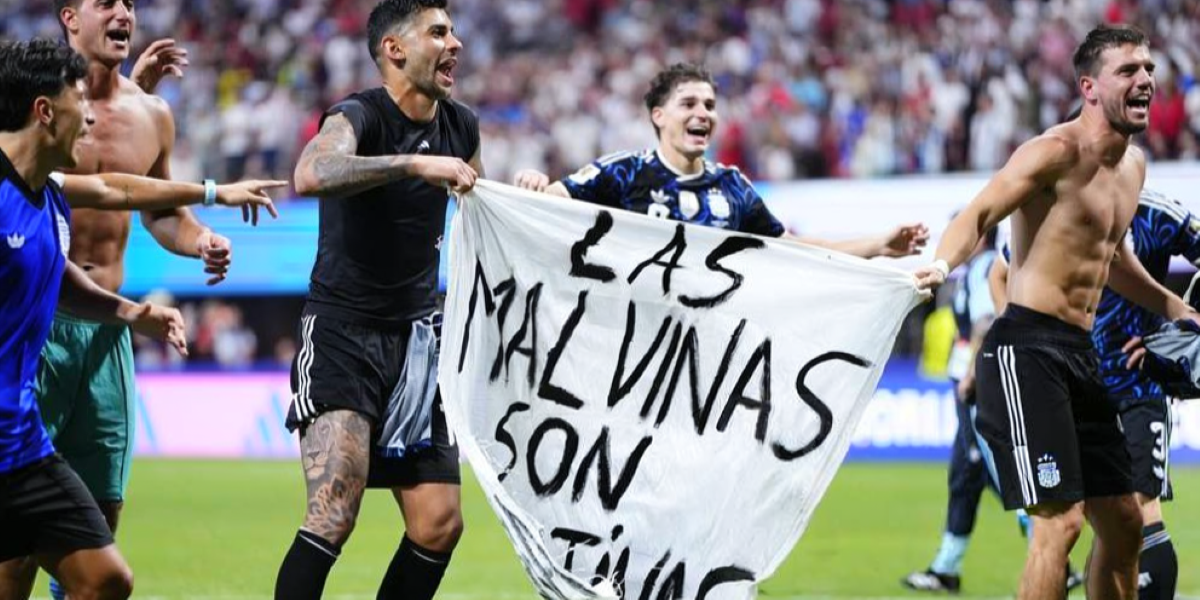
Argentina’s celebrations after reaching the World Cup final took a deeply controversial turn when several players displayed a banner laying claim to the Falkland Islands immediately after defeating England.
The defending champions had just completed a dramatic 2-1 comeback in Atlanta when Giovani Lo Celso and Lisandro Martínez were photographed holding a white banner carrying the words: “Las Malvinas son Argentinas.”
The message translates as: “The Falklands are Argentine.”
According to Reuters’ report published by Al Jazeera, the display appeared to breach FIFA’s rules restricting political messages at World Cup matches.
Read also: Javier Tebas breaks silence on what should happen to Man City next
The timing ensured the gesture would be interpreted as more than an expression of national pride. It was displayed on the pitch, in front of England supporters, only minutes after Argentina had ended the country’s hopes of winning its first men’s World Cup since 1966.
Players take banner from supporters
The banner was initially visible among the Argentine supporters before being passed onto the pitch during the post-match celebrations.
Sky News reported that the players took the banner from the crowd before posing with it in front of the stands.
Lo Celso was seen carrying the banner across the field, while Martínez helped hold it aloft as the Argentine squad celebrated reaching a second consecutive World Cup final.
Read also: Messi admitted he targeted one World Cup rival on purpose
The decision transformed a football victory into a provocative political statement concerning one of the most sensitive disputes between Argentina and the United Kingdom.
Although the players did not appear to direct the banner towards individual England players, the message was impossible to separate from the identity of the opposition they had just eliminated.
Argentina could face FIFA action
Political statements are prohibited inside World Cup stadiums, leaving Argentina at risk of disciplinary action.
FIFA had not announced an investigation or punishment at the time of publication. However, the governing body could examine whether the players or the Argentine Football Association brought the game into disrepute.
Read also: Cristiano Ronaldo crisis forces Portugal chief into emergency action
According to ABC News’ Reuters-based coverage of the controversy, any financial penalties linked to such incidents may not be issued until after the tournament.
That means Argentina are not currently expected to lose players for the final against Spain, although the incident threatens to overshadow preparations for the biggest match of the tournament.
FIFA now faces an uncomfortable test of its insistence that political messages have no place on the pitch. Failure to respond could expose the organisation to accusations of applying its rules selectively.
England collapse before controversial celebration
The banner appeared after Argentina had produced a stunning late comeback against Thomas Tuchel’s England.
Read also: Harry Kane breaks silence on Man City verdict
Anthony Gordon put England ahead in the 55th minute, leaving the Three Lions seemingly on course for their first men’s World Cup final in 60 years.
England then became increasingly defensive, allowing Argentina to dominate possession and create a succession of chances.
Enzo Fernández equalised in the 85th minute before Lautaro Martínez headed home Lionel Messi’s cross in stoppage time to complete the 2-1 turnaround.
Argentina’s players celebrated wildly after the final whistle, but the political message quickly became one of the most discussed images from the semi-final.
Read also: Phil Taylor comes out of retirement for stunning darts return
A dispute that remains deeply divisive
Argentina refers to the islands as Las Malvinas and continues to claim sovereignty over the territory, which is administered by the United Kingdom as a British overseas territory.
The dispute led to war in 1982 after Argentine forces invaded the islands. Britain subsequently sent a military task force and regained control following a conflict lasting more than two months.
For many Argentines, the sovereignty claim remains a defining national issue. For Britain and the islanders, however, Argentina’s continued claim is firmly rejected.
The vast majority of Falkland Islanders voted to retain their status as a British overseas territory in a 2013 referendum, although Argentina refused to recognise the legitimacy of the vote.
El País described the World Cup semi-final as a high-risk fixture, with the Falklands dispute already featuring prominently among supporters before kick-off.
Victory followed by provocation
Argentina will now face Spain in the World Cup final, while England must recover for a third-place play-off against France.
The holders have an opportunity to become the first team since Brazil in 1962 to retain the men’s World Cup, but their route to the final has now been accompanied by an avoidable political controversy.
Displaying the banner against any opponent would have been contentious. Displaying it immediately after eliminating England made the message considerably more provocative.
Argentina won the match on the pitch. Their players then ensured that a decades-old political conflict became part of the celebration.