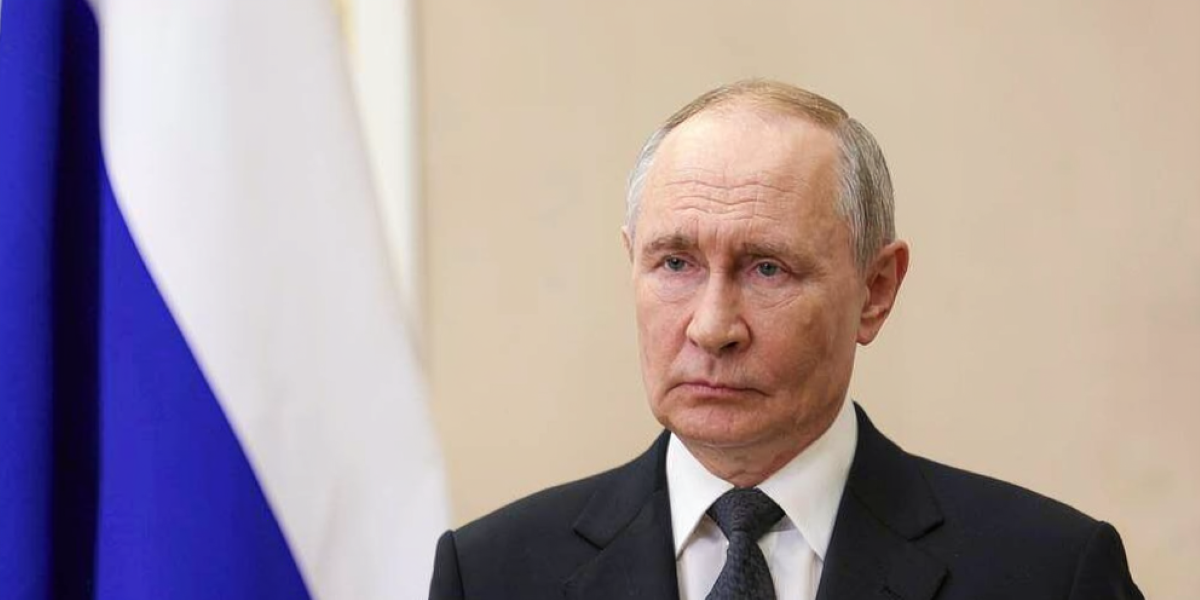
Vladimir Putin has been handed another symbolic victory in his attempt to bring Russia back into international sport.
From July 28, athletes holding Russian passports will once again be permitted to compete in events organised by the International Table Tennis Federation under the ordinary conditions applied to other competitors.
The decision covers individual and team competitions in both table tennis and Para table tennis, removing the special participation restrictions introduced after Russia launched its full-scale invasion of Ukraine in February 2022.
According to the ITTF’s official announcement of the decision, Russian athletes, coaches, officials and national delegations will be allowed to return to its events from Tuesday.
Read also: ‘If you lie to me, I will leave’: Guardiola’s City warning takes on new weight
The federation said returning competitors would still be subject to eligibility rules, anti-doping requirements, visa restrictions, national sanctions and security assessments.
The change may involve a relatively small sport, but its political significance stretches far beyond the table.
Russia’s sporting isolation begins to crumble
The ITTF acted after the International Olympic Committee provisionally lifted the suspension of the Russian Olympic Committee on July 7.
The suspension had been imposed in October 2023 after the Russian Olympic Committee absorbed regional sporting organisations from Ukrainian territories occupied by Russia.
Read also: Harry Kane’s Bayern future suddenly comes with a Tottenham escape route
The IOC said the Russian body had since removed those organisations and promised not to conduct activities in territories recognised as falling under the jurisdiction of Ukraine’s national Olympic committee.
As explained in the IOC’s statement on Russia’s provisional reinstatement, its previous recommendations restricting Russian athletes and teams are no longer considered applicable.
That change allows each international federation to decide whether Russian athletes can return and under what conditions.
The ITTF has moved quickly, allowing Russian competitors back into both individual and team events under its standard rules.
Read also: ‘I’m not confident’: Red Bull chief delivers troubling verdict on Verstappen’s car
However, the IOC has not yet decided whether Russia will be permitted to display its flag, colours or anthem at the 2028 Olympic Games in Los Angeles.
Ukraine condemns ‘unacceptable’ return
The Table Tennis Federation of Ukraine has strongly opposed the reinstatement of Russian and Belarusian competitors.
It argued that allowing athletes from the two countries to use national uniforms and state symbols was unacceptable while the war continued.
According to Inside the Games’ report on the Ukrainian response, the federation described the decision as unfair to Ukraine and incompatible with European security policy.
Read also: Man City hit back at Premier League with explosive accusation
The ITTF acknowledged the severe effect of the war on Ukrainian athletes, coaches, clubs and families but insisted that reinstating Russian competitors did not reduce its support for Ukraine.
It said restrictions on athletes must remain necessary, proportionate and objectively justified.
Ukrainian officials reject the suggestion that Russian sport can be separated from the state or the invasion.
They argue that many of Russia’s leading federations, clubs and athletes maintain close financial or institutional connections to the Kremlin, the military and state-owned companies.
Read also: Manchester City CEO says everything is one big “conspiracy theory”
Putin has already claimed sporting return as a victory
For Putin, the restoration of Russian national representation carries political value beyond medals and tournament results.
The Russian president has repeatedly presented international sporting success as evidence of national power and global legitimacy.
When Russian Paralympians regained the right to compete with national symbols, Putin described the development as a shared national victory.
“I am pleased that today our Paralympians are once again competing at major international competitions under their national symbols, flag and anthem,” Putin said in January.
“I consider this our major common victory.”
The statement was quoted by Inside the Games in its report on Putin’s reaction to the Paralympic reinstatement.
Russian sports minister Mikhail Degtyarev has also celebrated the removal of international restrictions.
He described the IOC’s latest decision as a green light for sporting federations to restore the rights of Russian athletes and national teams.
Following the ITTF announcement, Degtyarev praised what he called the combined success of Russian sporting diplomacy and legal action.
Protesters warn of propaganda victory
The controversy surrounding Russia’s return has already spread to other sports.
Russia’s women’s water polo team recently competed under its national identity at the World Cup finals in Sydney, prompting protests from members of Australia’s Ukrainian community.
Demonstrators accused sporting authorities of helping Moscow rehabilitate its international image while Russian attacks on Ukraine continued.
Ukrainian Council of New South Wales president Andrew Mencinsky described the team’s participation as a propaganda victory for the Kremlin.
“When they perform here, it sends a signal that Russia is welcomed back into the community of civilised nations,” he said.
“That is simply wrong.”
As reported in The Daily Telegraph’s coverage of the Sydney protests, demonstrators pointed to the deaths of Ukrainian athletes and the destruction of sporting facilities during the invasion.
The Australian government said it was disappointed by the decision to allow Russian and Belarusian teams to compete with national symbols but maintained that international federations were responsible for determining their participation rules.
European countries threaten financial action
Opposition has also emerged at government level.
Denmark, Estonia, Finland, Latvia, Lithuania, the Netherlands, Poland, Romania and Sweden have urged the European Commission to consider restricting financial support for sports organisations that readmit Russian and Belarusian competitors.
The nine countries argued that claims about separating sport from politics were impossible to accept while Russian sporting structures continued to be used by the state.
According to The Kyiv Independent’s report on the joint European intervention, the governments suggested excluding cooperating organisations from EU programmes and prominent EU-backed sporting platforms.
Their letter warned that Ukrainian athletes had been killed, displaced or forced to join the armed forces while defending their country.
The intervention demonstrates that federations restoring Russia may face political and financial consequences even when their decisions comply with the IOC’s new approach.
Football could become the biggest battleground
The most explosive confrontation may still be to come.
FIFA has indicated that it will review the IOC’s decision, potentially opening a route for Russian clubs and national teams to return to international football.
Russia has been excluded from FIFA and UEFA competitions since 2022. Its national team has therefore been unable to participate in qualifying for the World Cup or European Championship.
FIFA president Gianni Infantino has previously questioned whether the exclusion should continue, arguing that bans can create frustration and hatred rather than encourage peace.
UEFA and several powerful European football associations remain strongly opposed to Russia’s return while the invasion continues.
As described by The Guardian’s report on the potential FIFA and UEFA conflict, associations including those in England, Germany and France could refuse to play against Russian teams.
Even if FIFA lifted its own suspension, Russia would struggle to return to World Cup qualification without UEFA’s cooperation because the European governing body administers the qualifying tournament.
A premature reinstatement could therefore lead to boycotts, legal disputes and another major split between FIFA and UEFA.
A small decision with enormous political meaning
Table tennis does not possess the global reach of football or the Olympic Games.
Its decision nevertheless creates an important precedent.
Russian athletes and teams will return to an established international federation without the neutral conditions that defined much of their participation following the invasion.
The ITTF argues that competitors should not be punished indefinitely for decisions made by their government and that its approach is based on equal treatment.
Ukraine maintains that Russian sport remains closely connected to the state and cannot be separated from the Kremlin’s political objectives.
For Putin, the decision provides a valuable message.
Russia’s sporting isolation is beginning to weaken, one federation at a time.
Table tennis may have opened the door. The much larger battle over football, the Olympic flag and Russia’s complete sporting return is likely to follow.