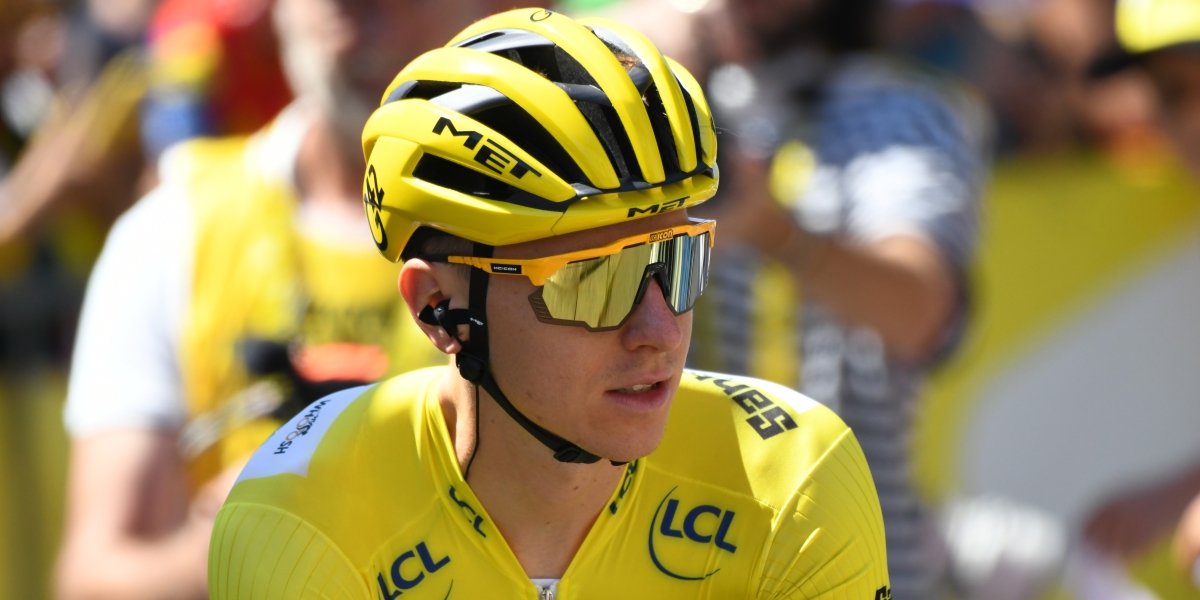
Tadej Pogačar has redefined modern cycling with his aggressive style and relentless dominance, securing multiple Grand Tour victories at a remarkably young age. Now, as first reported by BikeRadar, a forthcoming study suggests his physiological capacity might be even more extraordinary than previously imagined, with estimates placing his VO2 max potentially beyond currently documented human ranges.
The study, co-authored by Sebastian Sitko, Kristian Berg, and Pedro Valenzuela, and due for publication in the International Journal of Sports Physiology and Performance, estimates Pogačar’s VO2 max to be between 94 and 98ml/kg/min, averaging 96. This places the Slovenian phenom in an elite category, even surpassing the legendary three-time Tour de France winner Greg LeMond, who recorded a phenomenal 92.5ml/kg/min during his peak. For context, Lance Armstrong’s VO2 max was reportedly in the low 80s, while Chris Froome’s lab-measured figure was 84.4, adjusted to 88 for his racing weight.
According to BikeRadar, the study authors stated: “The results indicate that the athlete examined in this study exhibits an exceptionally high aerobic capacity that appears to extend beyond currently documented physiological ranges.” Such figures are a rarity in sports science, with Norwegian Oskar Svendsen famously registering 96.7 in a lab before winning the junior world time trial title in 2012, though his professional career was short-lived.
Rigorous methodology and validation
As reported by BikeRadar, the researchers analyzed Pogačar’s performance on four demanding climbs across the 2024 and 2025 seasons: Plateau de Beille and Isola 2000 from the 2024 Tour de France, Peyragudes from the 2025 Tour, and Passo di Ganda from the 2025 Giro di Lombardia. The model relied on assumptions regarding Pogačar’s weight, actual power output, and gross efficiencies (GE), using typical professional cyclist GEs between 22 and 24%.
Read also: Ferran Torres explains "Make Spain Great Again" hat after World Cup triumph
A crucial step in validating the model involved applying it to Chris Froome’s 2015 data. Sebastian Sitko, a sports science professor at the University of Zaragoza and co-author, explained the process: “Pogačar’s VO2 max was the goal, but the validated method turned out to be the more durable result. The pivotal step was testing it on someone we could check: we estimated Chris Froome’s VO2 max from a 2015 climb using only public data and landed at 85.3, against his lab-measured 84.4 – a difference of less than one point.” Sitko further highlighted the reliability of their power output calculations, confirming they were validated against actual power-meter files to within about 3%, a margin of error comparable to commercial power meters. Even with the most conservative settings, the study’s VO2 max estimate for Pogačar does not fall below 92.
Talent, skepticism, and the bigger picture
BikeRadar also reported that while the study presents compelling data, Pogačar’s camp has already reacted, with a Spanish outlet reporting their view that the figures are exaggerated. However, Pogačar’s career trajectory, including becoming the second youngest Tour de France winner at 21 in 2020, has generally fostered less skepticism compared to other top cyclists who found success later in their careers.
Greg LeMond, a vocal advocate for clean sport, has often spoken about innate talent, suggesting that some individuals are simply born with a physiological advantage that can make all the difference in top-tier competition. He contrasted this with athletes who “found” their talent later, implying a distinction from natural physiological endowments.
VO2 max, defined as the maximum amount of oxygen the body can use during intense exercise, is a key indicator of aerobic fitness potential. While lab tests can be influenced by various factors, this study’s real-world application of publicly available data offers a compelling, albeit debated, insight into the physiological engine driving one of cycling’s most dominant figures.
Read also: Pochettino extends USMNT stay through 2030 World Cup amid financial scrutiny
Read also: Williams sisters set for Cincinnati doubles return ahead of US Open