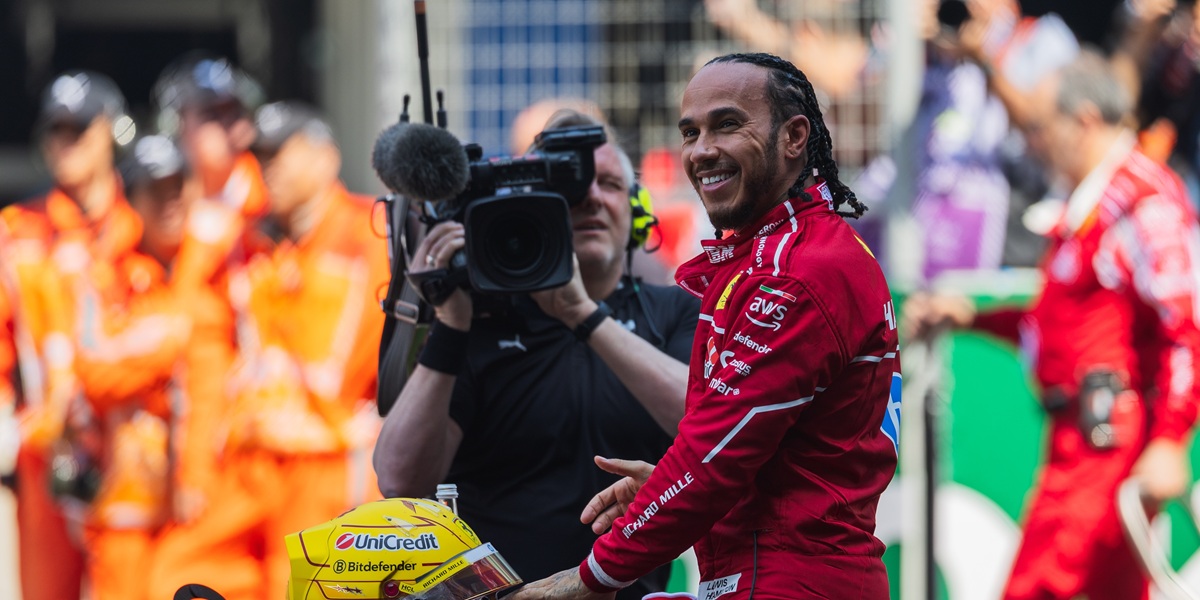
Kimi Antonelli called it insane. Lando Norris called it horrible. Carlos Sainz asked who signed off on the technical direction four or five years ago. Lewis Hamilton, who had to stop his Ferrari on track and restart the engine, said he had never done that before in a grand prix.
The flashpoint was a bug in the FIA-supplied wet-weather control code. On the formation lap at Sepang, cars slowed into a concertina behind the safety car, turbo revs collapsed, and the hybrid power units simply stopped delivering throttle. Hamilton’s Ferrari was the first affected, followed by both Audis, both Haas cars, both Cadillacs, an Alpine and a Racing Bulls, according to the FIA’s explanation.
Antonelli: “we were five-wide in the straight”
Antonelli, who leads the drivers’ standings, described the formation lap in disbelief.
“It was insane. At some point, we were five-wide in the straight, because we couldn’t understand what was going on.”
Read also: Guler has ‘closed and sealed’ his faith with Real Madrid
The Mercedes driver recovered to finish second behind Max Verstappen, with Hamilton third.
Norris, the reigning world champion, was blunt about the electronic failure.
“It’s just horrible. I don’t know, it just proves that we shouldn’t have any of that stuff, the electronic side.”
Hamilton: “I had to stop the car and restart it”
Hamilton spoke after the race about an experience he said was new in nearly two decades of grand prix racing.
Read also: Premier League giants circle Alejandro Balde as January door swings open
“I had to stop on track and stop the car and engine and restart it. I’ve never done that before.”
Hamilton said teams had been handed updated software code during the delay and had to flash it onto the cars.
“They had to update the software and then you have to load it into the car. I guess some had some faster laptops than others.”
He added that he hoped there was “a lesson learned.”
Read also: Smotherman wins first PGA Tour title
Sainz, writing off the entire regulatory direction, was the sharpest voice in the paddock.
“F1 needs to have a hard look at themselves and see how we ended up in this situation.”
“The regs are extremely complicated for the drivers, for the teams, for the PUs, for the manufacturers. It is too complicated.”
“That is what happens when there is so much software, so much controls involved. If it was a V8 aspirated, it would have never happened.”
Read also: Valter Walker breaks silence on the strange moment after his brother’s UFC 332 knockout
The Williams driver traced the fault back to decisions made long before the cars ever ran.
“Clearly what was decided four or five years ago is wrong.”
The FIA’s explanation
Nikolas Tombazis, the FIA’s single-seater director, said the problem had slipped through testing because teams had barely run in the wet all year.
“There are special configurations in the software for rain conditions, and there has been an error in the software. It has not been the teams’ fault.”
Read also: Erling Haaland injured: Here are the matches he’s in danger of missing
The governing body described the fault as an “unprecedented combination of low engine speed, low-grip conditions, wet-weather energy management settings and the Sepang circuit’s sector configuration,” and said an updated software release was distributed to all competitors during the rain delay. A full review with the power unit manufacturers has been promised.
Verstappen, the eventual winner, pinned the problem on the rulebook rather than the FIA’s code.
“That’s the problem that we have. These engines are so complicated and a lot of software is implemented.”
The Dutchman described how the car felt when the bug hit: “It was just like driving at 35 km/h going uphill, actually losing speed.”
Grand Prix Drivers’ Association director George Russell, who retired with a suspected power unit failure five laps from the end while running third, picked up the same theme.
“The power units are exceptionally complicated. The more complicated you make things, the more there is to go wrong.”
The paddock now heads to Marina Bay. The Singapore Grand Prix is scheduled for Sunday, 11 October.