Ousmane Dembélé’s hopes of making football history ended when France were beaten 2-0 by Spain in the World Cup semi-finals.
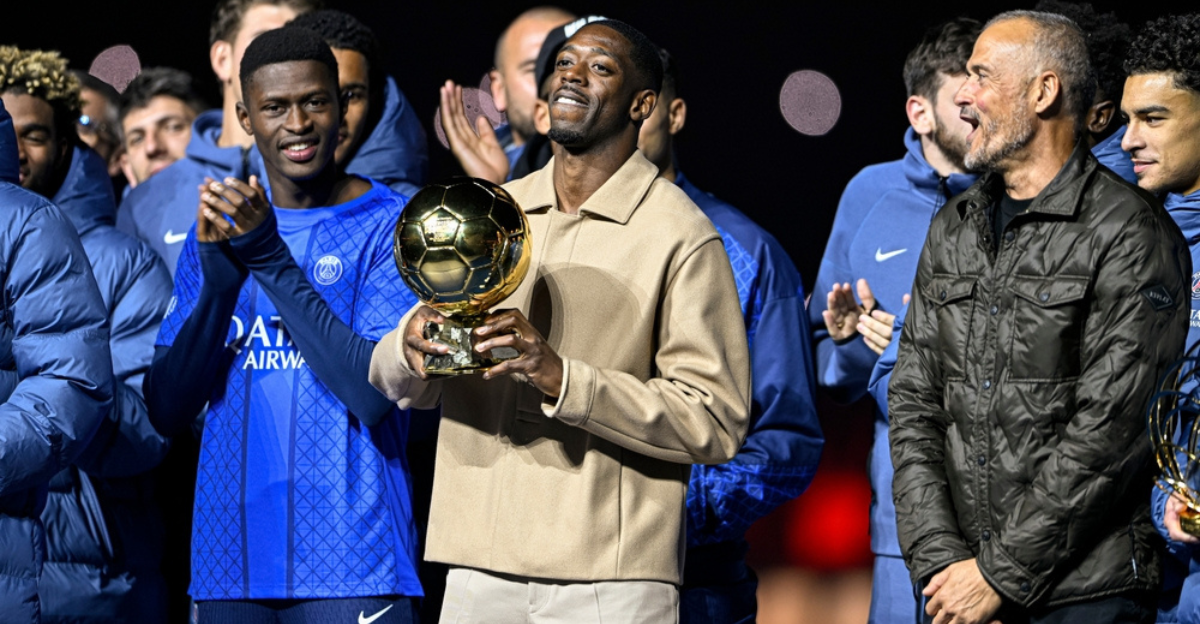
The Paris Saint-Germain forward entered the tournament as the reigning Ballon d’Or winner after receiving the prestigious individual award in 2025.
No player has ever arrived at a World Cup as the current holder of the men’s Ballon d’Or and gone on to win the tournament.
According to Elio Bono’s historical review for L’Équipe, Dembélé is now the third reigning winner to reach the semi-finals before being eliminated.
Read also: Kylian Mbappe had just hit top form – now Real Madrid have a problem
Dembélé unable to end historic sequence
Dembélé won the 2025 Ballon d’Or following an outstanding season with Paris Saint-Germain.
His achievement is recorded in France Football’s official list of Ballon d’Or winners, placing him alongside some of the most celebrated players in the history of the game.
He then scored five goals during France’s run to the World Cup semi-finals, including a hat-trick against Norway and the second goal in the quarter-final victory over Morocco.
France appeared capable of ending the pattern after winning their first six matches of the tournament. However, Dembélé and his fellow attackers struggled to influence the semi-final against Spain.
Read also: Premier League boss breaks silence with damning Manchester City statement
Mikel Oyarzabal converted a first-half penalty before Pedro Porro completed a deserved 2-0 victory after the interval.
As described in FIFA’s official match report, Spain frustrated France defensively and punished Didier Deschamps’ side at the other end of the pitch.
The result ended France’s attempt to reach a third consecutive final, although they will still contest the third-place play-off.
Platini and Eusébio also stopped in semi-finals
Before Dembélé, only two reigning Ballon d’Or winners had progressed as far as the World Cup semi-finals.
Read also: Kasper Schmeichel finds completely new path after football retirement
Eusébio received the award in 1965 after helping Benfica reach the European Cup final and establishing himself as one of the continent’s most feared forwards.
He scored nine goals for Portugal at the 1966 World Cup, finishing as the tournament’s leading scorer. Portugal were nevertheless beaten 2-1 by hosts England in the semi-finals before defeating the Soviet Union in the third-place match.
Michel Platini suffered a similar outcome two decades later.
The France captain arrived at the 1986 World Cup having won three consecutive Ballon d’Or awards between 1983 and 1985.
Read also: Andy Murray reveals one major regret about Nadal and Djokovic
Platini scored against Italy and Brazil during France’s run to the last four, but West Germany eliminated Les Bleus with a 2-0 victory in Guadalajara.
Dembélé has now joined the two European legends as a reigning winner whose World Cup challenge ended at the penultimate stage.
Five holders lost in the final
Several Ballon d’Or holders have come even closer to combining the individual award with World Cup success.
Italy’s Gianni Rivera reached the 1970 final, where Brazil produced a celebrated performance to win 4-1.
Read also: Manchester United told to ‘nick’ two Man City stars if relegation hits
Johan Cruyff and the Netherlands then lost 2-1 to hosts West Germany in 1974, despite taking the lead from the penalty spot before their opponents had touched the ball.
Karl-Heinz Rummenigge captained West Germany in the 1982 final but was unable to prevent Italy from securing a 3-1 victory in Madrid.
Roberto Baggio came within a penalty shootout of winning the tournament with Italy in 1994. After the final against Brazil finished goalless, Baggio sent the decisive penalty over the crossbar.
Ronaldo experienced another painful defeat four years later. The Brazilian had won the 1997 Ballon d’Or but struggled during the 1998 final as hosts France secured a 3-0 victory.
Those five players reached the deciding match as reigning Ballon d’Or winners, but none left with the World Cup trophy.
Other winners fell considerably earlier
The pattern also includes several players whose national teams failed to come close to the final.
Alfredo Di Stéfano’s Spain did not qualify for the 1958 tournament, while Denmark missed the 1978 World Cup after Allan Simonsen had won the award the previous year.
Marco van Basten and the Netherlands were eliminated by West Germany in the round of 16 in 1990.
Michael Owen, Ronaldinho and Lionel Messi suffered quarter-final defeats in 2002, 2006 and 2010 respectively.
Cristiano Ronaldo was eliminated in the group stage with Portugal in 2014 before losing to Uruguay in the round of 16 four years later.
Karim Benzema entered the 2022 tournament as the reigning winner but withdrew shortly before France’s opening match because of an injury.
A pattern rather than a genuine curse
Calling the sequence a “curse” offers an appealing storyline, but it does not suggest that winning the Ballon d’Or makes success at the World Cup less likely.
The tournament takes place only once every four years, while the individual award has historically been limited by different eligibility rules.
Until 1995, only European players were eligible to win the Ballon d’Or. Several World Cup-winning stars from Brazil, Argentina and Uruguay could therefore not have entered the tournament as reigning holders.
The World Cup’s knockout format also leaves little room for mistakes, regardless of a player’s individual reputation.
Dembélé arrived in North America as the latest winner of football’s leading individual award and produced several important performances for France.
He could not, however, achieve what Rivera, Cruyff, Rummenigge, Baggio and Ronaldo narrowly missed before him.
The unusual sequence will now continue until at least the 2030 World Cup.