The teenager knows, in data, exactly how far off Jeremy Doku he is. And in which parts of a winger’s game.
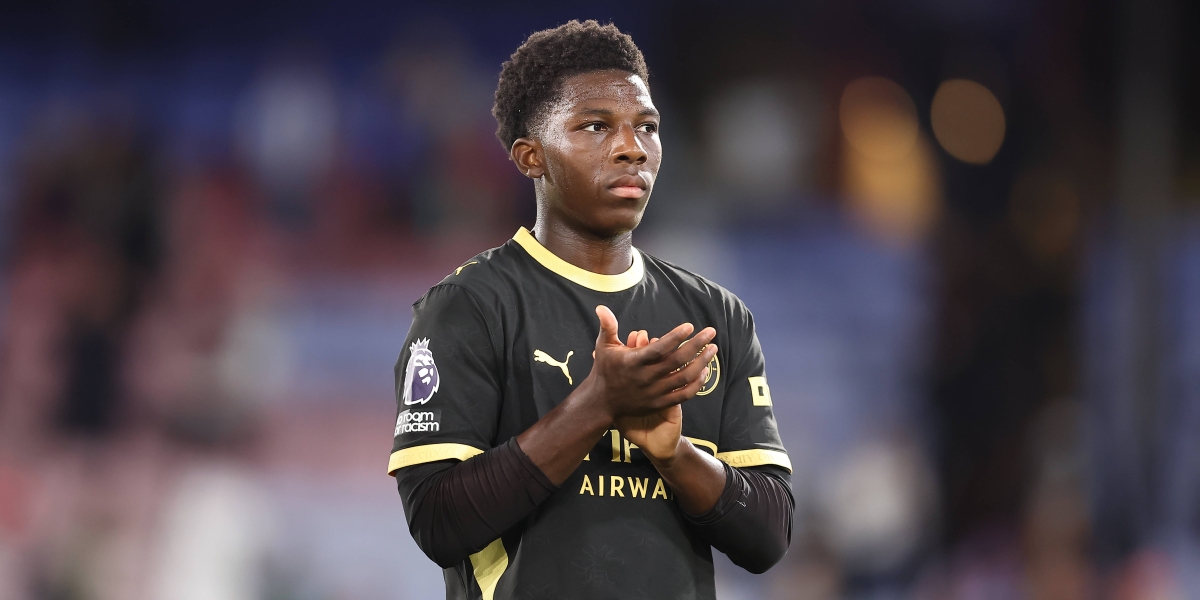
Manchester City are sending Ryan McAidoo’s numbers to an outside company that runs them through position-specific AI models and returns a comparative dashboard, letting the 18-year-old measure himself against senior wide men Jeremy Doku and Bournemouth’s Antoine Semenyo. City academy director Thomas Krucken described the setup as part of a wider “Future Player 2.0” programme aimed at closing the gap between academy standard and Etihad standard.
“We have a clear picture of what we want to develop for the future,” Krucken told the Manchester Evening News. “What is needed for the winger of the future, and what does Ryan McAidoo need to increase his levels?”
The framing matters. McAidoo is not being compared to a generic Premier League winger. He is being modelled specifically against Doku, the Belgium international at City, and against Semenyo, the Ghana international who recently signed a new contract at Bournemouth amid interest from Tottenham. Both are the yardstick the AI holds him against.
Read also: Arsenal’s €70m price tag stalls AC Milan pursuit of Gyökeres
What the AI actually looks at
City’s model breaks each position into its own set of key performance indicators. Centre-backs, for example, are graded across six variables tied to pass options. Wingers get their own set. McAidoo can then see, position by position and metric by metric, where he already matches Doku and Semenyo, and where the gap is still wide.
Krucken has framed the leap left to make in precise terms.
“When he came he was outstanding already, but it’s about the last, let’s say, five, ten per cent, and to prepare the player then for the demands of what we believe comes next,” he told Brit Brief.
That five to ten per cent is the space between an FA Youth Cup winner and a first-team player at a Champions League club. City are treating it as an engineering problem.
Read also: Dana White on ownership of new Las Vegas NBA Team: “YES”
Player in the driver’s seat
Part of the design is that McAidoo has to read the dashboard himself and act on it, rather than being told each week where to improve.
“The player should be in the driver’s seat for his development, not us who tell the player all the time, you have to do harder here,” Krucken said.
That philosophy sits alongside more traditional academy work. Individual training slots and Norwegian scanning-behaviour specialist Geir Jordet have been folded into the same Individual Development Programme under Krucken, who was appointed academy director in August 2023.
A prospect City are trying to keep
McAidoo, an English right winger born on 24 June 2008, joined City’s academy from Chelsea in summer 2024. He has since become one of the most talked-about names in the youth setup, and City are said to be facing competition to keep him tied down alongside two other academy prospects.
Read also: Abu Dhabi United Group financed them for years
Krucken’s stated ambition for the programme is not modest: he has spoken of eventually producing a Ballon d’Or winner from within the City Football Academy. An extended interview with Krucken is being released on the club’s Talking City podcast and YouTube channel.
Read also: Aymeric Laporte exposes ugly side of Pep Guardiola relationship