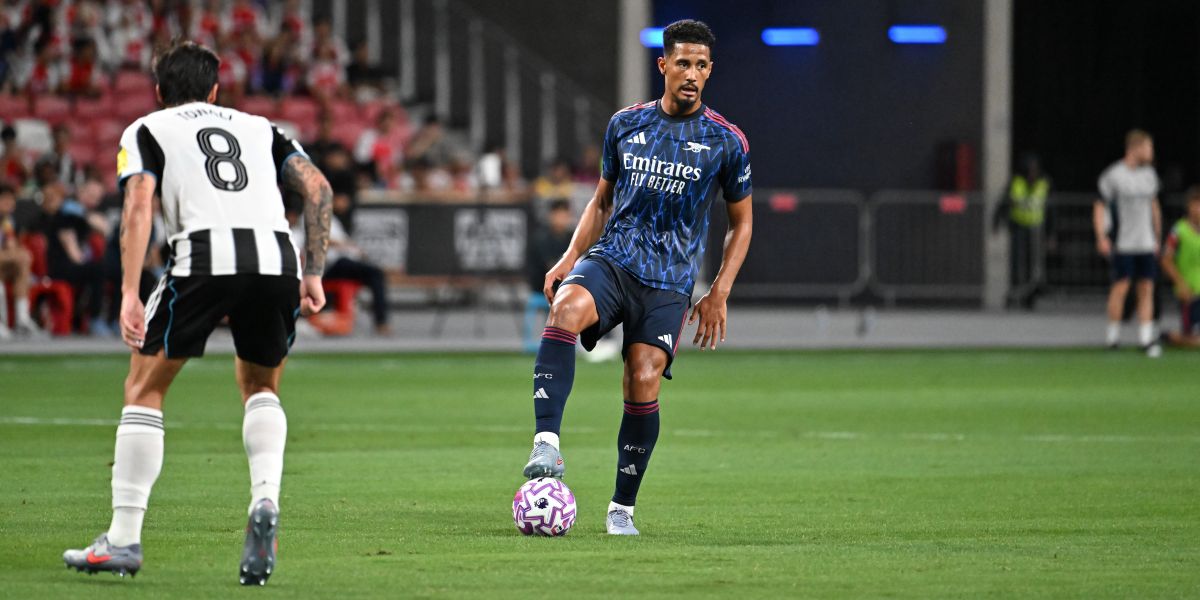
Arsenal fear William Saliba could be sidelined for up to five months after the defender’s long-standing back problem forced him out of France’s World Cup semi-final defeat to Spain.
Saliba went down without contact after half an hour of Tuesday’s match and was replaced by Maxence Lacroix. France were eventually beaten 2-0, ending their hopes of reaching a third consecutive World Cup final.
The 25-year-old is due to undergo further examinations before a final decision is made on his treatment. Surgery has not yet been confirmed, but it is currently considered the most likely course of action.
According to L’Équipe’s detailed report on Saliba’s condition, Arsenal are already planning for their central defender to be unavailable for four or five months when discussing potential transfer targets.
Read also: Harry Kane’s Bayern future suddenly comes with a Tottenham escape route
Pain becomes unbearable against Spain
Saliba had been struggling before he finally sat down on the pitch during the first half.
Television pictures did not capture the full extent of his discomfort, but L’Équipe reported that he had attempted several stretches during the opening stages, including around the time Spain were awarded their penalty.
Seconds before leaving the pitch, Saliba reportedly turned to defensive partner Dayot Upamecano and delivered a worrying message.
“I can’t take it anymore, my back is dead,” he said.
Read also: ‘I’m not confident’: Red Bull chief delivers troubling verdict on Verstappen’s car
Saliba had been managing the injury for several months. His training programme was significantly reduced during the World Cup, while recovery sessions and medical treatment were prioritised between matches.
He had also been relying on strong painkillers to make himself available for France.
The semi-final’s intensity eventually proved too much. Saliba pulled up while jogging with the ball and immediately reached towards his lower back before signalling that he could not continue, as described by NBC Sports in its report from the match.
Questions over decision to start him
The injury will inevitably raise questions over whether Saliba should have been allowed to play throughout the tournament.
Read also: Man City hit back at Premier League with explosive accusation
France’s staff were aware of the problem before travelling to North America. Saliba had already aggravated his back during Arsenal’s Champions League final defeat to Paris Saint-Germain and arrived at the national-team camp requiring an individual recovery programme.
He regularly missed training sessions during the World Cup and was rested for France’s group match against Norway. Outside competitive fixtures, the plan was for him to complete as little physical work as possible.
Saliba publicly acknowledged the problem in June.
“I’ve had a few niggles for several months. I’ve gritted my teeth,” he said, according to L’Équipe’s report from his World Cup press conference.
Read also: Manchester City CEO says everything is one big “conspiracy theory”
“It’s a World Cup, it only comes every four years. You have to grit your teeth. A lot of footballers play with niggles. Adrenaline plays a big part. I’m not at 100 per cent, but that’s the case for many players.”
Didier Deschamps repeatedly played down concerns, relying on information from Saliba and the French medical staff. However, L’Équipe has now questioned whether the manager was fully aware of how constant the pain had become.
Surgery now considered most likely option
Saliba will miss France’s third-place play-off against England and will return to Arsenal for further assessment.
No final decision has been made, meaning it would be premature to state definitively that he requires surgery. Conservative treatment remains possible, but an operation is reportedly the preferred option after months of attempting to manage the problem without one.
Read also: Pogacar’s home Euros go on without him, and now without Van der Poel too
The length of his absence will depend on the procedure and rehabilitation plan eventually chosen.
A four-month recovery would keep Saliba out until approximately November. A five-month absence could delay his return until December, ruling him out of a substantial part of Arsenal’s Premier League title defence and Champions League campaign.
The situation is particularly concerning because Saliba had carried a heavy workload before the World Cup. He made 43 appearances and played more than 3,700 minutes across the Premier League and Champions League during Arsenal’s 2025/26 season.
Arsenal’s transfer plans could change
Arsenal must now decide whether their existing defensive depth is sufficient to cover such a lengthy absence.
Saliba’s potential lay-off could force the club to accelerate plans for another centre-back before the transfer window closes. L’Équipe’s claim that Arsenal are already discussing his expected absence with possible targets suggests the club are preparing for the worst-case scenario.
The Frenchman had continued playing because of the importance of Arsenal’s run-in and France’s World Cup campaign. His determination helped both teams through decisive matches, but it may have come at a considerable cost.
Saliba wanted to push through the pain until the tournament was over.
His back gave way one match before the final, and Arsenal may now be without their defensive leader for almost half of the coming season.