Before Major League Soccer became the more familiar, globally aligned competition it is today, American professional soccer had a very different relationship with drawn matches.
In the years before MLS launched in 1996, and even around the time the United States hosted the 1994 FIFA World Cup, several American leagues preferred to avoid draws altogether. Instead, they leaned into a tie-breaking format that felt closer to an ice-hockey breakaway than a traditional football penalty.
According to Danish broadcaster TV 2, leagues such as the North American Soccer League and later the American Professional Soccer League used what became known as the American shootout. In the APSL, a tied match could go through two 7.5-minute periods of extra time before the shootout was used.
A duel from 35 yards
The format was simple, but it looked nothing like the penalty shootouts used in international football.
Read also: US becomes the first nation to host World Cup, while bombing one of the participants
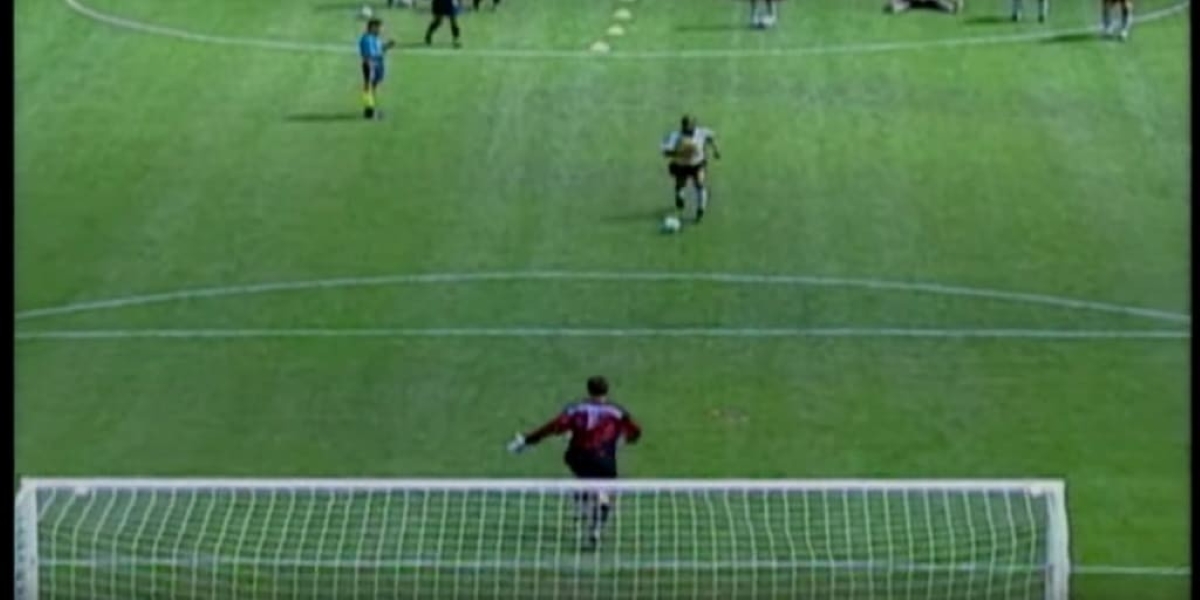
Instead of placing the ball on the penalty spot, the attacker started 35 yards from goal. From the first touch, the player had five seconds to score. The goalkeeper, meanwhile, was free to come off the line, close the angle and turn the attempt into a full one-on-one contest.
That gave the attacker several choices. They could shoot early, try to dribble around the goalkeeper or wait for the keeper to commit. The result was less static than a normal penalty, and often far more chaotic.
MLS later adopted the same idea when the league began in 1996. As the New England Revolution has described, tied games in the league’s first four seasons were decided by players dribbling from 35 yards with five seconds to release a shot.
MLS moved away from the experiment
The rule was part of a broader early MLS attempt to make the sport feel more familiar to American audiences. The league also used a countdown clock and gave fewer points for a shootout win than for a victory in regulation time.
Read also: Robert Lewandowski heading to Chicago Fire in major MLS move
In MLS, however, the shootout came after 90 minutes rather than after the APSL’s short extra-time format. If a league match was level at the end of regulation, the 35-yard contest decided which team took the extra point.
The experiment did not last. MLS used the format from 1996 through the 1999 season before moving away from it in 2000. The league has since followed the more traditional approach, with regular-season draws allowed and standard penalty shootouts reserved for matches that require a winner.
The specialists of a strange era
Although the format disappeared quickly, it produced its own small group of specialists.
Imad Baba became one of the standout performers of the era. According to the New England Revolution, he converted 11 of his 13 MLS shootout attempts, making him one of the most effective players in the format.
Read also: Thierry Henry on the unsung mentor who shaped his mind and the "tough love" that forged a legend
Goalkeepers had their own heroes too. Garth Lagerwey was particularly difficult to beat, while Jeff Cassar and Zach Thornton also developed strong records in the one-on-one format, according to TV 2.
Today, the 35-yard shootout survives mostly as a curiosity from American soccer’s experimental years. It was unconventional, sometimes divisive and certainly short-lived, but it remains one of the most distinctive rule experiments in MLS history.
Read also: Inflation reveals true cost of Premier League's most expensive transfers