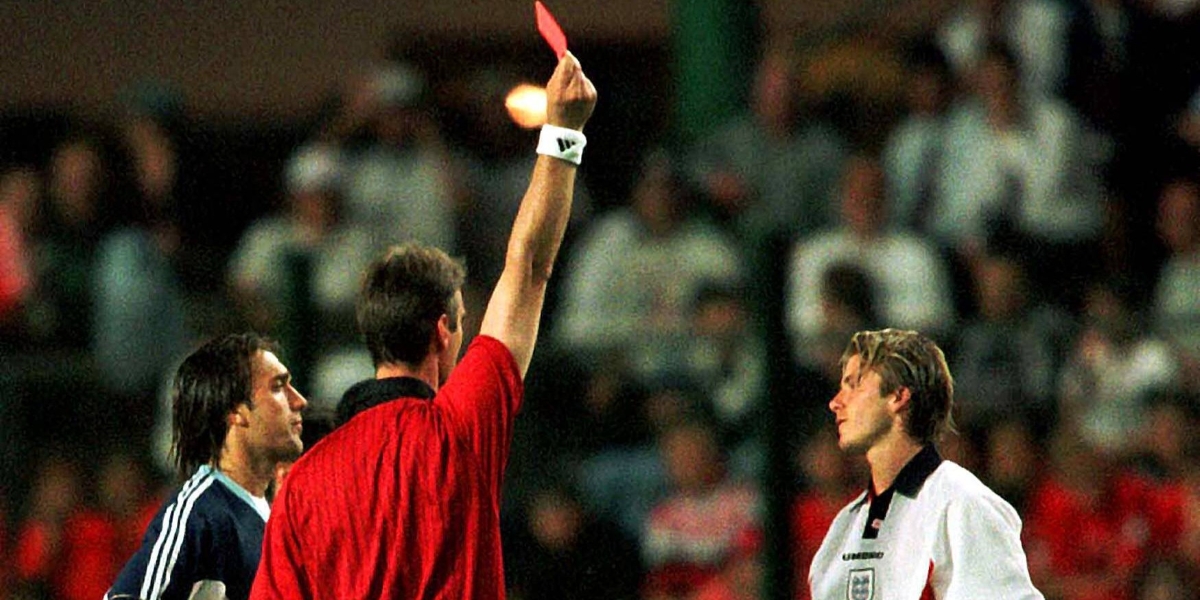
Twenty-eight years after showing David Beckham one of the most famous red cards in World Cup history, Kim Milton Nielsen has no regrets about his decision.
The former Danish referee dismissed Beckham during England’s dramatic round-of-16 meeting with Argentina in Saint-Étienne on June 30, 1998.
Beckham reacted to a foul from Diego Simeone by flicking his leg towards the Argentine midfielder while lying on the ground. Simeone fell dramatically, and Nielsen immediately produced a red card.
“I have a clear conscience about what I did,” Nielsen said, according to TV 2 Sport.
Read also: Roy Keane gives Manchester City stars brutal message over medals after guilty verdict
England survived with ten players and believed they had scored a late winner through Sol Campbell, only for the goal to be disallowed. The match remained 2-2 through extra time before Argentina won the penalty shootout 4-3.
Nielsen would make the same decision today
The dismissal has remained controversial because Beckham’s kick made limited contact and Simeone later acknowledged that he had exaggerated his reaction.
However, Nielsen insists the nature of Beckham’s retaliation justified the punishment.
The incident happened directly in front of the Danish official, who had already awarded England a free kick for Simeone’s original challenge.
Read also: Where Erling Haaland could end up if he leaves Man City
FIFA’s review of the 1998 encounter describes how Beckham raised his foot in retaliation “right under the nose” of Nielsen, who judged the action to be worthy of a red card.
Nielsen told TV 2 Sport that he would reach the same conclusion today, even if he had access to video footage.
The decision became one of the defining moments of Beckham’s career. England’s elimination was widely blamed on the then 23-year-old, who subsequently faced sustained abuse from supporters and sections of the British press.
Beckham later described his reaction as a “stupid mistake” and said the period that followed was one of the most difficult of his career.
Read also: Javier Tebas breaks silence on what should happen to Man City next
Simeone admitted influencing referee
Simeone has never denied attempting to influence Nielsen’s decision.
“Let’s just say the referee fell into the trap,” Simeone later said, as quoted by FIFA.
“You could say that my falling transformed a yellow card into a red card. In fact, the most appropriate punishment was a yellow one.”
Nielsen does not share that interpretation. He believes the punishment was determined by Beckham’s deliberate retaliation rather than the force of the contact or Simeone’s theatrical fall.
Read also: Messi admitted he targeted one World Cup rival on purpose
The former referee recently explained that he could not ignore the offence simply because it involved one of England’s leading players.
“I knew I couldn’t close my eyes just because it was David Beckham in a World Cup,” Nielsen said in an interview published by The Guardian.
The episode remains closely associated with him almost three decades later.
“It still takes up an incredible amount of space when you consider that it happened 28 years ago,” Nielsen told TV 2 Sport.
Read also: Cristiano Ronaldo crisis forces Portugal chief into emergency action
“It is still something people talk about, and naturally it becomes relevant again when the two countries meet.”
“VAR has destroyed football”
Although Nielsen is certain that video footage would have supported his decision, he is pleased that VAR did not exist during his refereeing career.
“I’m glad there was no VAR when I was a referee, because it has really destroyed football,” Nielsen said.
The former official believes referees should be trusted to make decisions based on what they see in real time rather than relying heavily on slow-motion replays and lengthy reviews.
VAR was introduced to correct clear and obvious mistakes, but its use has frequently generated debate over delays, marginal offside decisions and the interpretation of contact inside the penalty area.
For Nielsen, the system has removed part of the immediacy that once defined the game.
His criticism is particularly striking because the Beckham incident is often cited as a decision that could have benefited from a video review. Different camera angles showed both the limited force of Beckham’s kick and the exaggerated nature of Simeone’s fall.
Nielsen nevertheless maintains that neither detail would have changed the central fact: Beckham deliberately kicked towards an opponent after play had stopped.
Refereeing career included major finals
Nielsen became a FIFA-listed referee in 1988 and developed into one of Europe’s most experienced officials.
He refereed at the 1998 and 2002 World Cups, taking charge of the semi-final between Brazil and Turkey at the latter tournament.
His assignments also included matches at three European Championships, the 2001 Intercontinental Cup and the 2004 Champions League final between Porto and Monaco.
UEFA described Nielsen as one of Europe’s leading officials when appointing him to that final.
He became the first referee to take charge of 50 Champions League matches before ending his career in 2006.
Nielsen later refereed Beckham on several occasions, but the pair never discussed the World Cup dismissal.
Rivalry revived in Atlanta
The incident has returned to public attention ahead of England and Argentina’s World Cup semi-final in Atlanta.
It will be their first competitive meeting since the 2002 World Cup, when Beckham scored the only goal from the penalty spot to secure an emotional victory for England.
The rivalry also includes Argentina’s celebrated victory in 1986, when Diego Maradona scored both the “Hand of God” and his extraordinary solo goal in Mexico City.
The 1998 encounter added another chapter through Michael Owen’s memorable strike, Javier Zanetti’s clever free-kick goal and Beckham’s dismissal.
England ultimately failed to progress, while Argentina were eliminated by the Netherlands in the quarter-finals.
For Beckham, the red card became a painful turning point before his eventual redemption four years later. For Nielsen, it remains the decision that has followed him more than any other.
His verdict has not changed with time.
He saw a deliberate act of retaliation, applied the punishment he believed the laws demanded and remains convinced that he made the correct call.