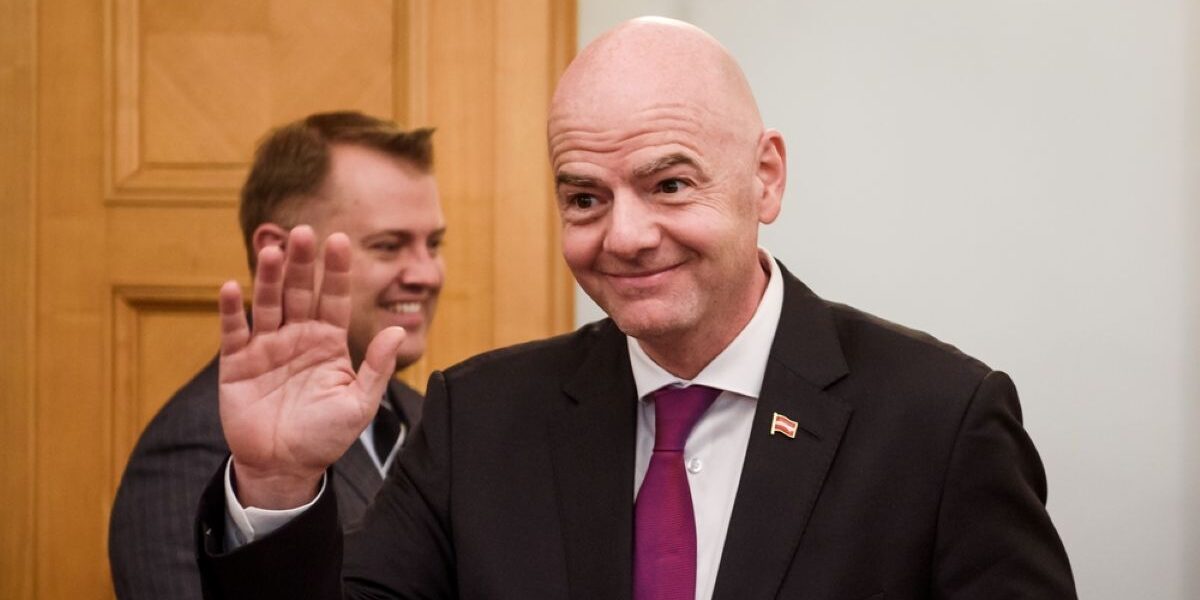
The nomination deadline is still more than three months out and Infantino has repeatedly insisted he intends to stand for re-election. But the past ten days have shifted the picture. After a coordinated push from UEFA, CONCACAF and Asia’s AFC, Infantino was forced to scrap his proposal to open FIFA competitions, the World Cup included, to outside investors.
Within hours, UEFA had gone further than any confederation before it. In a statement, UEFA said “the current FIFA leadership has not only lost UEFA’s confidence but also that of many other members of the football family” and warned that “no option should be off the table” in the review that will follow.
That is the political weather in which the next FIFA presidential race is beginning. Below, ranked, are the five names most seriously in the frame.
1. Nasser Al-Khelaifi
The loudest name in European boardrooms is also the most reluctant. The Paris Saint-Germain president chairs European Football Clubs, sits on the UEFA Executive Committee and has, since October 2025, represented the EFC on the FIFA Council.
Read also: Media reports: Cole Palmer linked with Premier League giants on one condition
He is one of the few people in the game who could plausibly build a coalition across UEFA and the Gulf states in months rather than years.
He does not want the job. A source close to Al-Khelaifi told RMC Sport at the end of July that he has “absolutely no ambition, no intention, nor any interest” in the FIFA role and would continue to “quietly support” the game’s institutions.
That statement predates UEFA’s formal loss-of-confidence declaration, which is why several European federations are still circling him as a unifying challenger. His Qatari ownership of PSG and beIN would remain a lightning rod in any campaign.
Strength: unrivalled convening power across Europe and the Gulf. Weakness: has said, through his people, that he does not want to run.
Read also: Arteta has picked up the phone to Vinicius Jr as Real Madrid brace for a Premier League record
2. Victor Montagliani
If the anti-Infantino movement is going to settle on a viable candidate, several recent reports point to the CONCACAF president.
The Canadian is a decade into running the confederation, holds a FIFA vice-presidency and was co-chair of the 2026 World Cup delivery.
Journalist Ben Jacobs reported this week that “Victor Montagliani would draw big support from UEFA if he stands” and that the Canadian is understood to be receptive, noting that a CONCACAF-UEFA alignment could deliver up to 96 votes at Congress.
The politics fit: on 1 August, CONCACAF’s own statement described a “comprehensive reckoning with this presidency” as “imperative”, the sharpest public break to date between Montagliani’s confederation and Zurich.
Read also: Paredes faces three FIFA charges, but retirement offers no clean escape
Strength: a live candidacy trajectory, with UEFA-CONCACAF math that stacks up. Weakness: yet to declare, and would still need to explain why he can beat an incumbent that African and, historically, Asian confederations have backed.
3. Aleksander Ceferin
The UEFA president is the successor European federations would probably choose if they could pick anyone.
He led the public rebellion against the investor plan and remains the most visible voice of anti-Infantino Europe.
The obstacle is that Ceferin has already signalled he wants out. He announced in February 2024 that he would not seek a fourth UEFA term in 2027, citing burnout and long stretches away from his family, and he has given no public indication of wanting to move to Zurich instead.
Read also: Sir Alex Ferguson rejected Zlatan Ibrahimovic for one surprising reason
His leverage right now is precisely the leverage of a leader on the way out: no career left to protect, no calculation left to soften the criticism.
Strength: the incumbent challenger everyone in Europe understands. Weakness: repeatedly indicates he wants out of football administration, not further into it.
4. Sheikh Salman bin Ebrahim Al Khalifa
The AFC president has been here before. He lost to Infantino in the 2016 election and has since built the Asian confederation into a reliable Infantino ally, which is what makes his intervention over the investor plan so striking.
In correspondence to AFC’s 47 member associations, Sheikh Salman branded the proposal “totally unacceptable” and pulled Asia into the boycott coalition that ultimately broke it.
Read also: Roc Nation attacks ‘fake and damaging’ reports amid Vinícius transfer storm
Sheikh Salman is FIFA’s senior vice-president and remains politically active. A second candidacy is not being openly promoted, but he is one of the few figures who could combine a personal history of opposition to Infantino with genuine reach into the Gulf and beyond.
Strength: experience, seniority, and a live rupture with the incumbent. Weakness: lost heavily to Infantino a decade ago and would have to redraw the same electoral map.
5. Lise Klaveness
The Norwegian Football Federation president is the dark horse.
A former international player and lawyer, Klaveness has spent her four years leading the NFF as one of FIFA’s most persistent internal critics, from the run-up to Qatar 2022 through to the Saudi 2034 bid and, this year, an ethics complaint against Infantino over the FIFA Peace Prize handed to Donald Trump.
She would be the first woman elected FIFA president, an enormous barrier in a Congress historically dominated by men, and Norway is not a heavyweight bloc.
But if reformist member associations coalesce around a governance ticket rather than a political operator, Klaveness is the candidate the piece Sports Illustrated ranked first among five potential successors this week for a reason.
Strength: the only name on the list whose brand is FIFA reform itself. Weakness: limited base, unprecedented gender barrier, and short runway to build a global coalition by November’s deadline.
The nomination window closes on 18 November. Whether any of these five files papers, and whether Infantino faces a real challenger for the first time since 2016, will be settled by then.