Jude Bellingham has revealed what was said during his heated exchange with Lionel Messi in England’s dramatic World Cup semi-final defeat to Argentina.
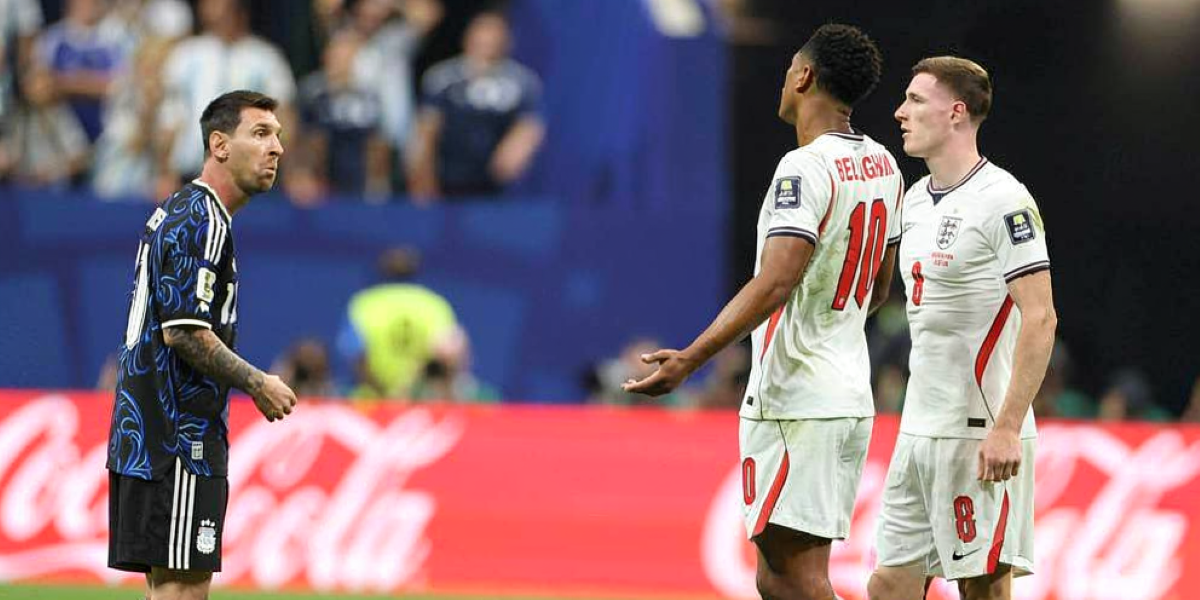
Television cameras captured the two players arguing during a fiercely contested first half in Atlanta, with Messi appearing to respond dismissively before walking away.
The footage quickly spread online and was presented as a symbolic confrontation between two generations: the 39-year-old Argentina captain and the 23-year-old Englishman widely regarded as one of the leading players of the next era.
Bellingham, however, insisted there was no personal hostility behind the incident.
Read also: Harry Kane’s Ballon d’Or response says plenty without saying much
Disagreement begins with two fouls
The exchange followed a physical opening period in which referee Ismail Elfath regularly had to stop play.
Leandro Paredes had challenged Bellingham late before Enzo Fernández committed another foul on Elliot Anderson. England’s players believed Argentina’s repeated infringements should have resulted in stronger punishment.
Messi later complained about a separate challenge against him, prompting the disagreement with Bellingham.
“Were we talking about Messi? We were discussing a foul, actually,” Bellingham said, according to AS’s account of his post-match explanation.
Read also: Roy Keane gives Manchester City stars brutal message over medals after guilty verdict
“But it was nothing bad. I’m sure everyone will do their thing and make it a big deal, but it was nothing really.
“I thought there was a foul earlier and he said, ‘Well, what about the one on me?’ And I was kind of saying, ‘You’re strong enough to take it,’ you know what I mean?”
The first half produced 19 fouls and only limited attacking football, underlining the intensity surrounding the first World Cup meeting between England and Argentina since 2002.
Bellingham dismisses personal rivalry
Although the exchange appeared confrontational, Bellingham made clear that his respect for Messi had not been affected.
Read also: Where Erling Haaland could end up if he leaves Man City
“There was nothing against him,” the England midfielder said.
“I’m obviously on the losing side, which hurts a lot, but it’s a privilege to go against him.”
That explanation offered a different interpretation of a moment initially framed as a confrontation between Argentina’s established icon and England’s emerging leader.
Before the semi-final, the clash between the two number 10s had been identified as one of the match’s defining storylines. Messi entered the contest as Argentina’s leading scorer, while Bellingham had carried England through the quarter-final by scoring twice against Norway.
Read also: Javier Tebas breaks silence on what should happen to Man City next
On the pitch, their duel was less about individual tricks than influence, physical resistance and the ability to survive a match played under enormous pressure.
Messi ultimately has the final word
Bellingham and England initially appeared to be moving closer to the final when Anthony Gordon opened the scoring in the 55th minute.
Argentina responded by pushing England deeper into their own half. Messi, who had been closely marked for much of the contest, eventually found the space required to decide the semi-final.
He provided the pass for Enzo Fernández’s equaliser in the 85th minute before crossing for Lautaro Martínez to head home the winning goal two minutes into stoppage time.
Read also: Messi admitted he targeted one World Cup rival on purpose
According to FIFA’s official match report, Messi was named player of the match after assisting both goals in Argentina’s 2-1 victory.
The result sent the defending champions into Sunday’s final against Spain and left England facing another painful semi-final elimination.
Viral moment told only part of the story
The confrontation between Messi and Bellingham became one of the most widely shared images from the match, but Bellingham’s comments suggest the reality was considerably less dramatic than the footage implied.
It was not a declaration of a personal rivalry or a passing of the torch. It was an argument between two fiercely competitive players over what each believed the referee had missed.
The two exchanged words, defended their positions and continued playing.
Messi ultimately left with a place in the World Cup final. Bellingham left with disappointment, but also with the experience of facing one of the players whose career has defined the modern game.