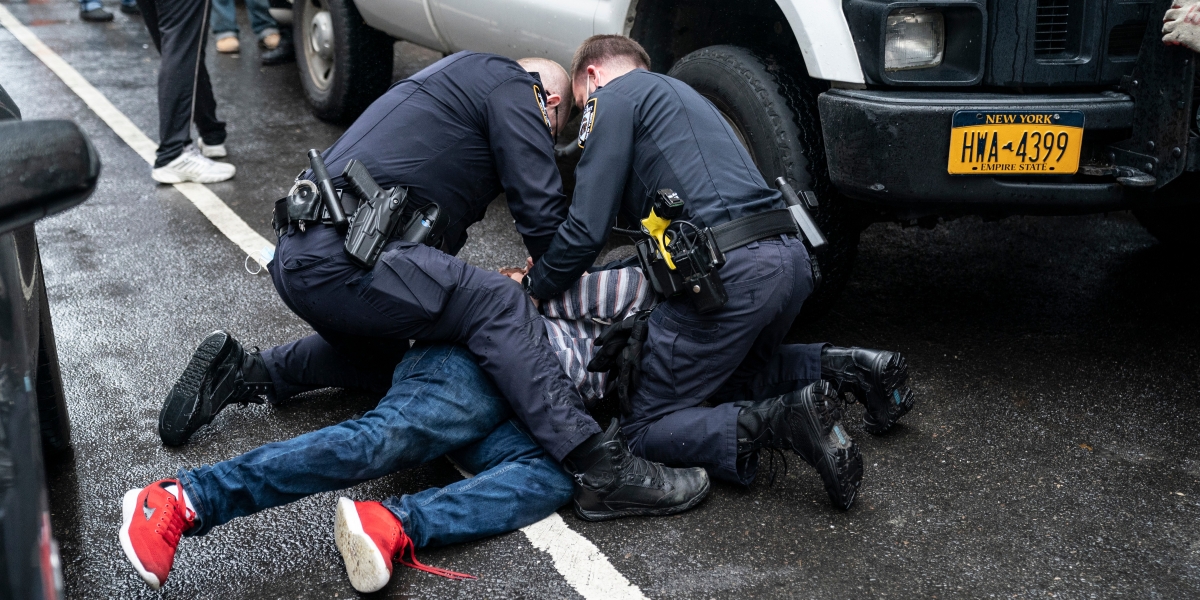
Armed police detained several England and Argentina supporters after fighting erupted outside Atlanta Stadium following Wednesday’s World Cup semi-final.
The disorder began shortly after Argentina completed a dramatic 2-1 comeback, ending England’s hopes of reaching their first men’s World Cup final since 1966.
Photographs taken by the PA news agency showed supporters arguing and fighting in the streets surrounding the stadium. Officers were seen separating groups, placing fans in handcuffs and leading several people away from the area.
According to The Scottish Sun’s report on the disturbances, two supporters from opposing sides were arrested after becoming involved in a street fight, while further detentions were made as police attempted to restore order.
Read also: Leeds will receive huge compensation from Manchester City
Several Argentina fans were also photographed confronting officers, while a small group of supporters wearing England shirts were seen sitting or standing in handcuffs.
The precise number of arrests and the nature of any potential charges had not been officially confirmed at the time of publication.
Violence follows heightened security operation
The trouble came despite Atlanta Police increasing its presence before a fixture already considered at risk of disorder.
Additional officers and resources had been deployed around the stadium, entertainment areas and other busy parts of the city as part of a wider World Cup security operation.
Read also: Huge Super League twist as Real Madrid head back towards old allies
In a statement issued before the semi-final, the Atlanta Police Department said it had strengthened its public safety posture ahead of the match and would position extra personnel around major gathering points.
The majority of England and Argentina supporters attended the fixture without becoming involved in trouble. However, sporadic fighting outside the stadium provided an ugly conclusion to an evening already marked by hostility on the pitch and political tension away from it.
Reports and images also documented separate altercations in Birmingham and New York following the final whistle. There was no evidence that the incidents were coordinated.
Vice-president inflamed political tensions
The build-up to the match had been dominated by the historic and politically sensitive relationship between the two countries.
Read also: Zidane is in focus, Deschamps is in the dark
Argentina’s vice-president, Victoria Villarruel, intensified the atmosphere by describing the English as “usurping pirates” in a social media post before kick-off.
“We play against the usurping pirates. It’s not just another match,” Villarruel wrote, as quoted in an AFP report published by Al Jazeera.
“I’m not going to be politically correct or keep a cool head – it’s always something more against the English.
“It’s the Malvinas, it’s Diego, it’s Leo’s last run, and it’s about stopping the invaders in their tracks.
Read also: Harry Kane’s Ballon d’Or response says plenty without saying much
“Go Argentina! Because until our very last breath, we will keep claiming what is ours!”
Her comments referred to the Falkland Islands, known in Argentina as Las Malvinas, and the continuing sovereignty dispute between Argentina and the United Kingdom.
Villarruel’s father fought in the 1982 Falklands War, in which 649 Argentine military personnel, 255 British personnel and three islanders were killed.
Argentina coach Lionel Scaloni had adopted a noticeably different position before the match, urging supporters to treat the semi-final as a football contest rather than an extension of the countries’ political history.
Read also: Roy Keane gives Manchester City stars brutal message over medals after guilty verdict
Players display Falklands banner
The political controversy continued after Argentina’s victory.
Several Argentina players displayed a banner carrying the words “Las Malvinas son Argentinas”, meaning “The Falklands are Argentine”, during the celebrations on the pitch.
Giovani Lo Celso and Lisandro Martínez were among those photographed holding the banner after it had been passed down from the stands.
The gesture risked breaching FIFA regulations restricting political messages inside stadiums and ensured that the Falklands dispute remained part of the post-match discussion.
The islands are administered by the United Kingdom as a British overseas territory, while Argentina continues to claim sovereignty over them.
In a referendum held in 2013, 99.8 per cent of participating islanders voted to retain their political status. Argentina does not recognise the vote as a legitimate resolution of the dispute.
The rivalry has also been shaped by footballing controversies, including Diego Maradona’s “Hand of God” goal in 1986 and David Beckham’s red card when the teams met at the 1998 World Cup.
As described by CBS News in its examination of the rivalry, matches between the two countries have carried political and emotional significance far beyond the pitch for four decades.
Argentina complete dramatic comeback
England had appeared close to securing a place in the final after Anthony Gordon opened the scoring in the 55th minute.
Morgan Rogers delivered the ball across the penalty area, allowing Gordon to convert from close range and give Thomas Tuchel’s side a 1-0 lead.
England subsequently dropped deeper and allowed Argentina to dominate the closing stages.
Enzo Fernández equalised in the 85th minute before Lautaro Martínez headed home Lionel Messi’s cross two minutes into stoppage time.
The late goal secured Argentina’s 2-1 victory and a place in Sunday’s final against Spain. England will instead face France in the third-place play-off.
The Associated Press match report described Argentina’s victory as another demonstration of the defending champions’ resilience after they overturned England’s lead during a relentless late attack.
The football was dramatic enough on its own. The fighting outside the stadium and the political gestures that followed ensured the controversy continued long after the final whistle.