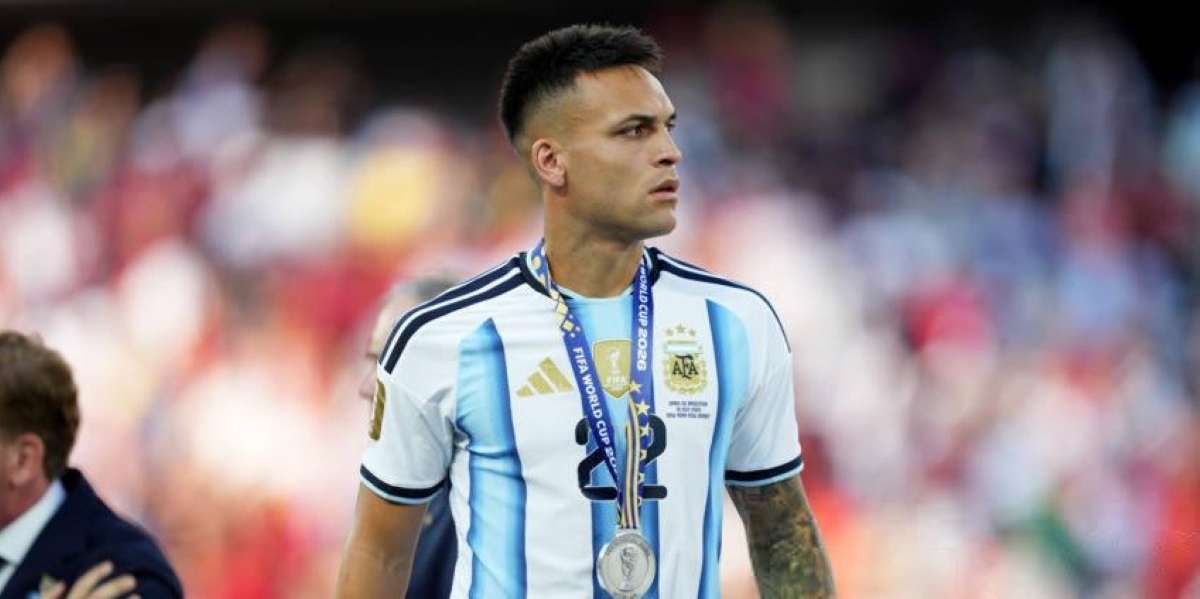
Lionel Scaloni has made hundreds of decisions during the most successful period in Argentina’s recent history. Few have generated as much debate as the decision not to use Lautaro Martínez in the 2026 World Cup final.
Argentina spent 90 minutes against Spain without registering a single attempt at goal. They eventually lost 1-0 after extra time, yet the striker who had scored the winning goal in the semi-final remained on the bench throughout the match.
The controversy might have faded if Lautaro had remained completely silent. Instead, an Instagram interaction has raised questions about whether one of Argentina’s most important players also believes Scaloni made a decisive mistake.
The Instagram like that changed the story
According to La Nación’s report on Lautaro’s social-media activity, the Inter captain liked a post describing his absence from the final as “Scaloni’s worst mistake”. The post argued that the striker had repeatedly delivered when Argentina needed a late goal during the tournament.
Read also: Arsenal’s €70m price tag stalls AC Milan pursuit of Gyökeres
A social-media like is not the same as a public attack on the manager. It can be accidental, emotional or interpreted more strongly than the player intended.
The reaction nevertheless carried weight because of Lautaro’s own message after the final. “I would have liked to try to help the team on the pitch, but never mind,” he wrote while reflecting on Argentina’s defeat.
The wording was controlled and respectful, but the disappointment was clear. Lautaro had watched the most important match of the tournament from the bench despite believing he could change it.
Argentina desperately needed a goal
The strongest argument against Scaloni is found in the match statistics. Spain controlled the final from the opening minutes, while Argentina failed to produce a single attempt during normal time.
Read also: Abu Dhabi United Group financed them for years
According to FIFA’s official report from the final, Spain forced Emiliano Martínez to make 12 saves before Ferran Torres finally scored in the 106th minute. Argentina’s defensive resistance was remarkable, but its attacking threat was almost nonexistent.
Lautaro appeared to represent the most obvious solution. He had scored three goals during the tournament and had already shown that he could make an immediate impact from the bench.
He provided an assist after entering against Egypt, scored against Switzerland and then delivered the 92nd-minute winner against England in the semi-final. His header sent Argentina into the final only four days before Scaloni decided not to use him.
The player who had just saved Argentina
Argentina were heading out against England when Scaloni turned to Lautaro. The striker entered the match, attacked the penalty area and converted Lionel Messi’s cross in stoppage time.
Read also: Dana White on ownership of new Las Vegas NBA Team: “YES”
The official FIFA statistics from the semi-final show that Argentina produced 15 attempts compared with England’s five. Lautaro supplied the decisive finish after the pressure had finally broken England’s defence.
His performance appeared to confirm his value as a substitute. Lautaro did not need an entire match to influence the result, making him an obvious candidate when Argentina required one moment against Spain.
That is why the final substitution became so controversial. With Argentina trailing and playing with ten men, Scaloni selected defender Marcos Senesi instead of the striker who had rescued the previous match.
Scaloni’s defenders have a strong argument
The decision cannot be judged without considering the problems Scaloni faced. Both of Argentina’s starting central defenders suffered injuries, forcing Nicolás Otamendi and Facundo Medina into the match.
Read also: Aymeric Laporte exposes ugly side of Pep Guardiola relationship
Enzo Fernández was then dismissed after receiving a second yellow card shortly before extra time. Argentina had to confront Spain’s relentless pressure with ten players and an improvised defence.
Scaloni’s decision to introduce Senesi was therefore not simply a refusal to attack. He needed another defender because his team was exhausted, numerically disadvantaged and attempting to survive against the tournament’s strongest possession side.
There was also a tactical reason for starting Julián Álvarez. His pressing, movement and defensive work were considered important against a Spanish team that builds patiently from the back.
Could Lautaro and Messi have played together?
The real question might not be whether Lautaro should have replaced Álvarez. Scaloni could instead have used the Inter striker alongside Messi and attempted to give Argentina a permanent target inside the Spanish penalty area.
Read also: Manchester City face new panel that could reopen the 115-charge verdict
That approach would have carried considerable risk. Messi was 39, Argentina were down to ten players and Spain were already finding spaces around the edge of the defensive block.
Adding a striker could have weakened the midfield and allowed Spain to settle the final before extra time. Scaloni chose control and survival, hoping the match might reach penalties.
The plan almost worked. Argentina resisted until the 106th minute, and even after Torres scored, they remained one action away from forcing a shootout.
A manager should not be judged by hindsight alone
Scaloni has earned considerable trust. He led Argentina to the Copa América titles in 2021 and 2024, the Finalissima and the 2022 World Cup before reaching another final in 2026.
It is easy to say Lautaro should have played after Argentina failed to score. Had Scaloni introduced him and Spain immediately exploited the additional space, the coach would have been criticised for abandoning the defensive structure.
Managers make decisions without knowing what happens next. Supporters analyse them with the final score already available.
That does not make the criticism invalid. It simply means the debate must consider what Scaloni knew at the time, rather than only what happened afterwards.
Lautaro’s reaction creates a new problem
The Instagram like suggests that the issue may not be limited to supporters and journalists. Even if Lautaro did not intend to challenge Scaloni publicly, his reaction indicates that he recognised the criticism of the manager.
That matters because Argentina are entering an uncertain period. Scaloni’s long-term future has not been fully resolved, while the team must also prepare for the possibility of continuing without Messi.
Lautaro should be one of the leaders of the next cycle. Any tension between the captain of Inter and the most successful Argentina coach of the modern era would therefore become more than a disagreement about one substitution.
There is no public evidence of a serious breakdown between them. The like has created questions, but it has not proved the existence of a dressing-room conflict.
The decision that will follow Scaloni
Argentina might have lost even if Lautaro had played. Spain were the better team, controlled the ball and created enough opportunities to deserve the trophy.
Yet football history is often shaped by the player who was not selected. Lautaro had scored the semi-final winner, was fully available and watched every minute of a final in which Argentina barely attacked.
Scaloni’s decision was tactically understandable. It may also have been the biggest mistake of his career.
What do you think? Was Scaloni right to protect Argentina’s defensive structure, or should Lautaro have entered the moment the team needed a goal?