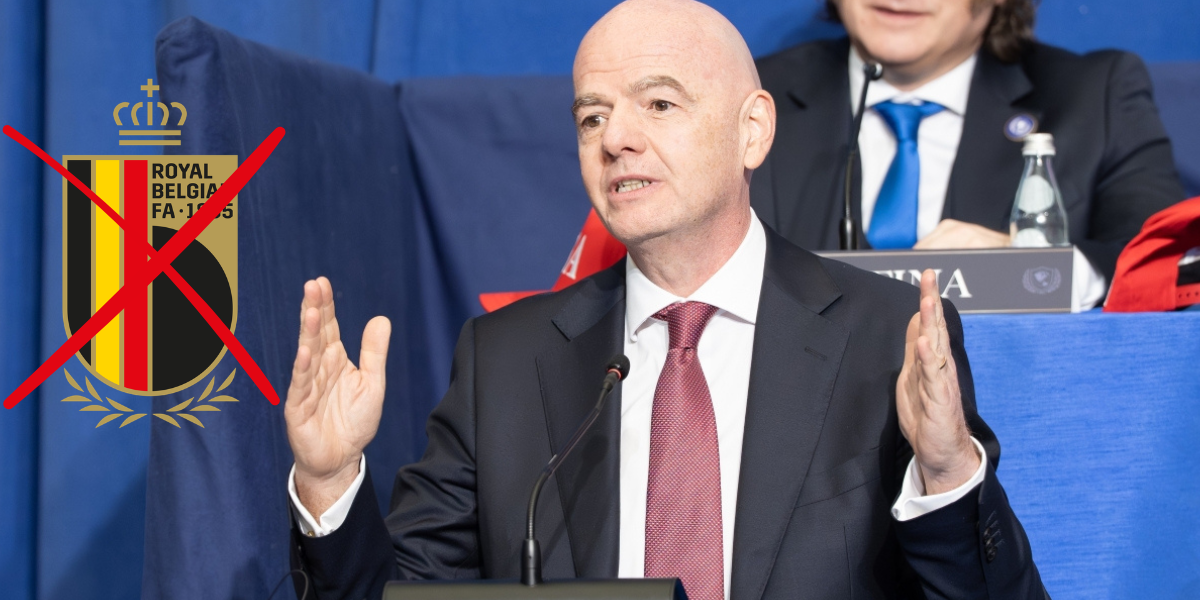
Belgium has become the latest European federation to publicly break with the FIFA president, and the first to tie its refusal explicitly to the Balogun ruling in the summer’s knockout rounds. The RBFA said on Monday that questions it put to FIFA more than two months ago remain unanswered, and it has asked for the case to be placed on the FIFA Council’s agenda for 15 October.
“Two months after the events, we note that our questions remain unanswered to date,” RBFA president Pascale Van Damme said in the federation’s statement.
The board’s decision covers two governance files. Alongside the Balogun ruling, the RBFA pointed to FIFA’s handling of the shelved plan to sell stakes in the World Cup and other competitions to private investors, the so-called FIFA Forward Enterprise (FFE) proposal that was withdrawn on 1 August after a joint intervention by UEFA and its 55 member associations.
The red card that changed the tournament
Balogun was sent off in the 64th minute of the round-of-32 tie against Bosnia and Herzegovina on 1 July for stepping on defender Tarik Muharemovic’s ankle. The United States won 2-0 and advanced to face Belgium in the last 16.
Read also: Roy Keane goes nuclear on Man City after 114 guilty findings
That should have made him automatically unavailable for the next match. Instead, U.S. president Donald Trump called Infantino after the game to argue that Balogun should not have been sent off.
FIFA’s disciplinary judge then invoked Article 27 of the disciplinary code, replacing the automatic one-match ban with a deferred one-year probation and a $40,000 fine. It was the first World Cup red card suspension to be reversed since 1962.
Belgium appealed. About seven hours before kick-off in the last-16 tie, the FIFA Appeal Committee ruled the challenge inadmissible. Balogun took the field and the United States went through.
A wider revolt against Infantino
Wales became the first federation to publicly withdraw support for Infantino’s re-election on 3 August, citing “recent failures in good governance”. The English FA followed shortly after, aligning itself with UEFA, which had already said on 1 August that it had lost “confidence” in the FIFA president.
Read also: Here is Foden’s Man City exit route
Belgium’s move adds a second, distinct file, the Balogun ruling, to the FFE governance case that has driven most of the earlier criticism. Confederations do not decide their member associations’ votes; any FIFA presidential election is settled by individual ballots from 211 federations. But the pattern of public defections is now widening beyond the FFE dispute alone.
The election calendar
FIFA confirmed on Sunday that Infantino will stand for a fourth and final term.
“Of course, nothing has changed. Mr Infantino will be standing for re-election,” a spokesperson said.
Nominations close on 18 November, with the election scheduled for 18 March 2027 in Rabat.
Read also: Rodri breaks silence on Man City verdict with remarkable 2020 comparison
The Belgian federation has asked for the Balogun case to be added to the FIFA Council meeting on 15 October.
Read also: The wheelchair champion beat the sub-two-hour man, and London Marathon has its 2027 schedule