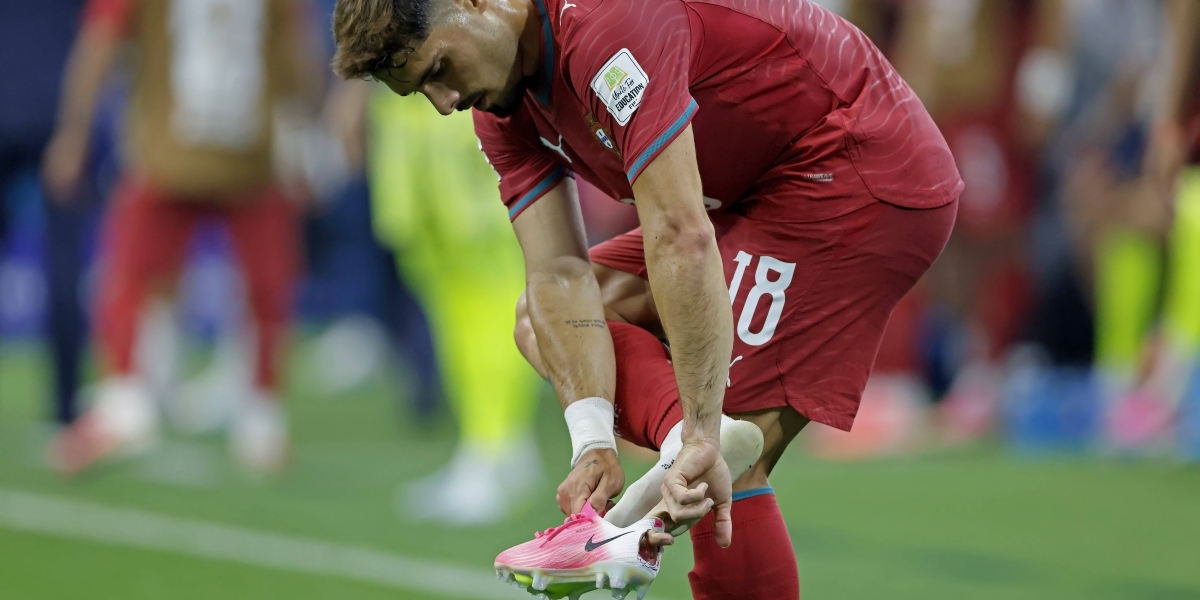
It has become one of the stranger sights of the World Cup: elite footballers taking the pitch with holes cut into their socks, and in some cases even the backs of their boots.
Jude Bellingham, Bukayo Saka and Kyle Walker are among the England players who have been seen with modified matchday gear, prompting fans to ask why some of the world’s best-paid athletes appear to be playing in damaged kit.
The answer is more practical than fashionable. For many players, the changes are about reducing pressure, easing discomfort and trying to remove small irritations that can become significant over 90 minutes at the highest level.
According to UNILAD, players cutting holes in the backs of their socks is not accidental wear and tear, but a deliberate adjustment made before matches.
Read also: Jamie Carragher: ‘always felt’ Man City were guilty
Socks cut to release pressure
The most common version of the trend involves holes cut into the calf area of football socks.
Modern match socks are designed to be tight. They help keep shin pads in place and offer support, but some players feel that the compression becomes uncomfortable during matches, especially when sprinting, accelerating and changing direction repeatedly.
One theory is that cutting holes into the socks reduces tension on the calf muscles and gives players a greater feeling of freedom.
Described by WIRED, the practice has been seen across major tournaments for years, but there is still no clear scientific evidence that it improves performance or reduces injury risk.
Read also: Dana White missed Fury vs Joshua’s kickoff
That does not mean the players are imagining the discomfort. WIRED noted that calf muscles repeatedly expand during sprints and changes of direction, which can create a feeling of pressure when tight socks are constantly compressing the area.
In a sport where comfort and confidence matter, that may be enough for players to keep doing it.
Boots modified around the heel
The more eye-catching version is when players cut sections out of the back of their boots.
That is usually linked to heel pressure. Football boots are tight by design, and the heel area can rub badly during matches. For players dealing with blisters, Achilles irritation or general soreness, cutting away part of the boot can reduce friction.
Read also: Leeds will receive huge compensation from Manchester City
According to UNILAD, Dr Donald Grant, a GP and senior clinical advisor at The Independent Pharmacy, said one possible explanation is Haglund’s syndrome, also known as “pump bump”.
He described it as being caused by “irritation around a bony prominence at the back of the heel.”
“It’s particularly common among athletes, including football players, due to tight boots, repeated sprinting and sudden changes of direction, all of which can increase the risk of irritation, leading to this injury,” Dr Grant said.
A quick fix, not a cure
Haglund’s syndrome is usually associated with a bony enlargement at the back of the heel, an inflamed bursa and irritation around the Achilles tendon.
Read also: Huge Super League twist as Real Madrid head back towards old allies
For footballers, the problem can be made worse by rigid boots repeatedly rubbing against the same area. Cutting the back of the boot can therefore offer immediate relief by reducing contact and pressure.
But Dr Grant warned that it should not be seen as a real treatment.
“While this can definitely reduce pressure on the heel and help avoid friction, it should not be viewed as an effective way to treat the injury,” he said.
“Many players use this as a quick, practical way to manage discomfort during a match, but it’s not a proven way to prevent it.”
Read also: Zidane is in focus, Deschamps is in the dark
He added that properly fitted footwear with heel support and padding remains the better long-term approach.
Small margins at the highest level
The trend may look odd, but it fits the logic of elite football.
At a World Cup, players are looking for tiny improvements wherever they can find them. A tight sock, a rubbing boot or a painful heel can become more than a minor irritation when matches are decided by a single sprint, turn or shot.
There is no proof that cutting socks makes players faster, and there is no suggestion that every modified boot points to the same medical issue.
But for the players, the reasoning is simple: if removing a small piece of fabric or leather helps them feel more comfortable, it is worth doing.
The holes may look strange from the stands, but on the pitch they are part of a familiar elite-sport calculation. Anything that helps a player feel ready to perform is unlikely to disappear quickly.