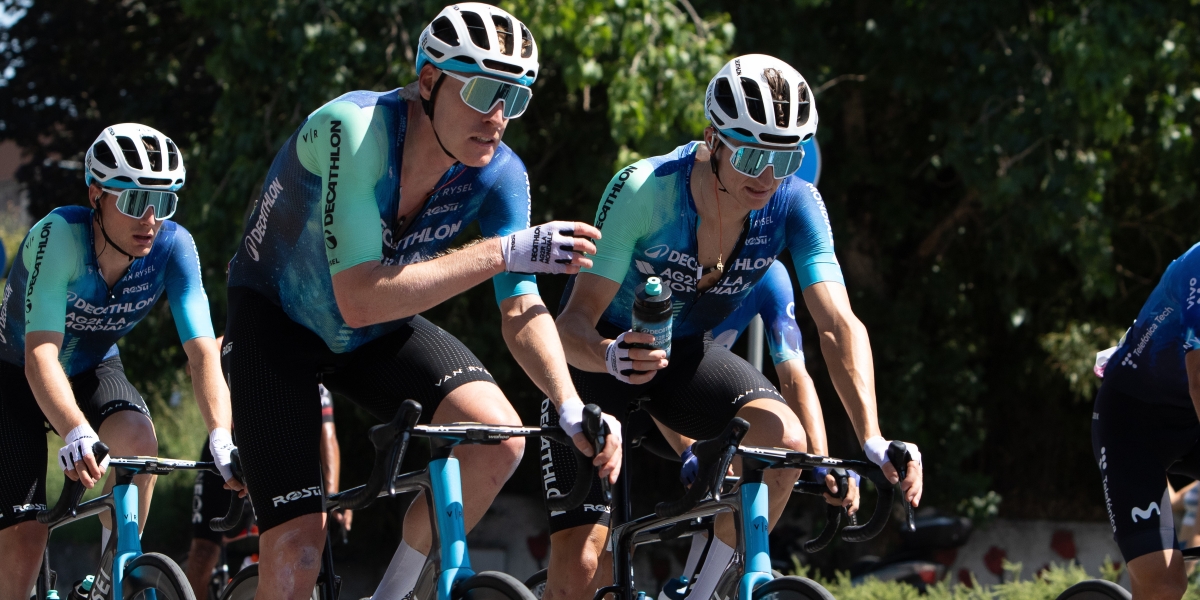
As the Tour de France peloton rides through punishing heat, Jonas Vingegaard and several of his Visma-Lease a Bike teammates have criticised the rules that decide when and where riders can receive bottles, ice and food.
Temperatures have pushed towards 40 degrees Celsius in the opening week, turning hydration into one of the central issues of the race. Riders have been taking bottles, ice socks, cooling vests and extra drinks wherever the rules allow, but Visma believe the current system is still too restrictive.
According to Tuttobiciweb, the UCI has temporarily relaxed the rules during the heatwave by allowing musettes, or feeding bags, in some zones that were originally reserved only for water bottles.
Vingegaard wants more freedom
For Vingegaard, the changes do not go far enough.
Read also: Manchester United told to ‘nick’ two Man City stars if relegation hits
Speaking to TV 2 Sport, the Dane said: “I want to race in the heat, but when it’s this hot, it should be made free.”
He added: “Then perhaps one should say that they can give bottles, ice, and whatever they want, at all places where it is defensible.”
His argument is not that riders should avoid the heat completely. It is that once the race is taking place in such conditions, access to cooling and hydration should be treated primarily as a safety issue.
The fourth stage, won by Mads Pedersen in Foix, was raced in extreme conditions. Described by The Guardian, the peloton faced 40C-plus heat over 181 kilometres and four categorised climbs, with extra bottles and more drinks motorbikes used as emergency measures.
Read also: Thierry Henry issues blunt warning over Liverpool’s £123m signing
Jorgenson warns of chaos near the cars
Matteo Jorgenson also believes the current system creates unnecessary danger.
“The problem in the heat is that the UCI limits the number of feeding zones,” Jorgenson told TV 2 Sport.
“It would be much better if we were allowed to get provisions wherever we want on the stage. The main reason is that it creates chaos when riders have to go back and forth to the cars within one kilometer.
“It wasn’t like that before, when we could get provisions whenever we wanted. It was safer. So it’s a shame, and I hope they change that rule.”
Read also: Roy Keane goes nuclear on Man City after 114 guilty findings
Sepp Kuss made a similar point, saying that if the official zones are roughly 20 kilometres apart, it becomes extremely difficult for riders to return to the car, collect bottles and cool themselves properly.
That is the practical problem in the peloton. The hottest days do not only test the riders’ legs. They also force teams to make constant decisions about who drops back, when bottles are collected and how many riders are exposed to the risks of moving through the convoy.
UCI has already moved, but only partly
The UCI’s temporary measure was designed to help teams distribute more bottles at once in designated climbing zones.
According to Cyclingnews, the governing body’s Extreme Weather Protocol allows countermeasures such as increased hydration and cooling, and in the most severe cases can even include neutralisation or cancellation.
Read also: Here is Foden’s Man City exit route
Tour director Christian Prudhomme also said organisers were ready to adapt, with more ice for teams, more feed zones and extra motorbikes carrying water bottles.
But for Visma’s riders, the issue is not only whether more water exists. It is whether it can be collected safely and often enough when the heat is at its worst.
Fairness question complicates the debate
The counter-argument is competitive balance.
TV 2 Sport expert Emil Vinjebo said he understood the Visma riders’ frustration, but warned that unlimited feeding could favour the biggest and richest teams.
Read also: Rodri breaks silence on Man City verdict with remarkable 2020 comparison
“They have a point. And at first, I – like the two Visma Americans – was also annoyed,” Vinjebo said.
“But there is also the other side of it, which is that big teams like Visma have unlimited resources. So they can just hire a lot of people to stand in all sorts of places on the route. And not all teams can do that.
“Then there will be a difference between the teams. And I’m not a big fan of that. And there shouldn’t be soigneurs every meter of all climbs either. That would be too much.”
That is the dilemma for the UCI. More open feeding could make the race safer in extreme heat, but it could also widen the gap between wealthy teams and smaller squads with fewer staff and less logistical power.
Heat debate is only getting louder
The issue is unlikely to disappear. Cycling’s calendar is increasingly being tested by extreme summer temperatures, and the Tour’s traditional afternoon racing window puts riders on the road during some of the hottest hours of the day.
According to the UCI, SafeR has already been monitoring feed-zone flexibility as summer heat becomes a growing concern in European races, including allowing feeding on categorised climbs.
That direction suggests the sport knows it has a problem. The question is how far the rules should move.
Vingegaard and his teammates want the freedom to take what they need when conditions become extreme. Vinjebo’s concern is that too much freedom could turn hydration into another area where the strongest teams become even stronger.
For now, the Tour continues in the heat, and the debate over bottles, ice and fairness is becoming part of the race itself.