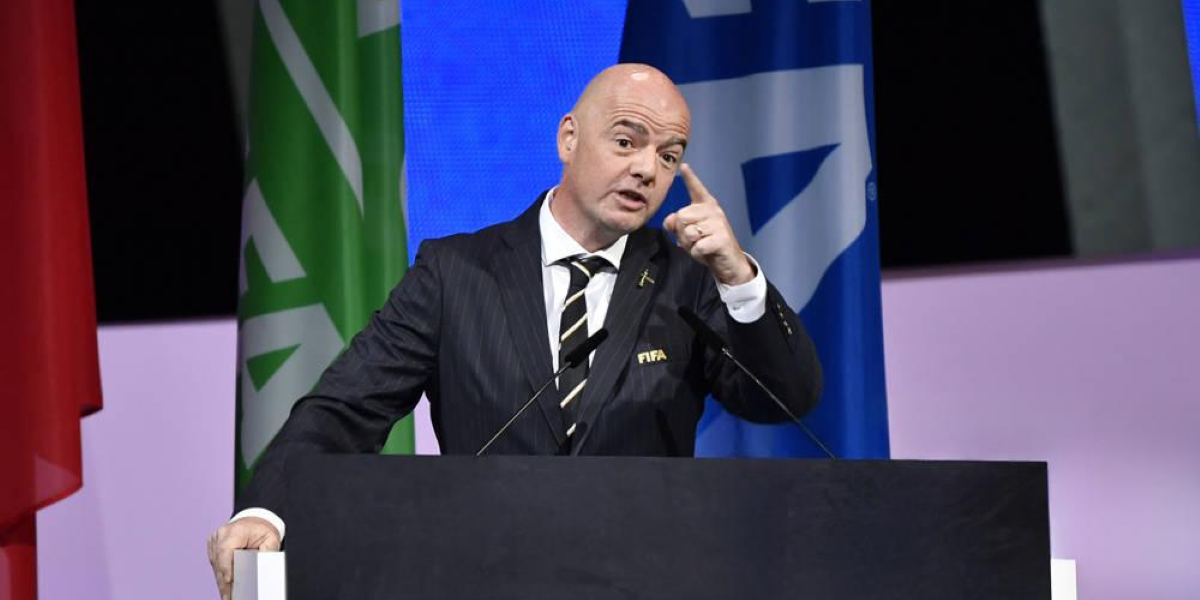
Gianni Infantino is already on course to remain FIFA president until 2031, with several of football’s most powerful confederations publicly lining up behind him ahead of next year’s election.
The FIFA president confirmed at the organisation’s congress in Vancouver that he will stand for re-election in 2027. The vote is scheduled to take place at the 77th FIFA Congress in Rabat, Morocco, where Infantino is widely expected to extend his time at the top of world football.
According to FIFA, Infantino told the 211 member associations at the 76th FIFA Congress that he would seek another term.
The numbers already favour Infantino
FIFA’s presidential election is built on a simple principle: each of the organisation’s 211 member associations has one vote.
Read also: Dana White missed Fury vs Joshua’s kickoff
That means a candidate needs 106 votes to secure a majority. Infantino already appears to have cleared that line.
According to Reuters, republished by The Star, CONMEBOL gave Infantino its backing in April, bringing support from South America’s 10 member associations.
The African bloc then followed. Described by ESPN, CAF publicly confirmed unanimous support from all 54 of its member associations.
Asia has also moved in the same direction. According to Al Jazeera, the Asian Football Confederation has also backed Infantino, adding 47 more votes.
Read also: Leeds will receive huge compensation from Manchester City
Together, those three blocs amount to 111 votes, five more than the majority required.
“He is as good as untouchable”
For Jens Sejer Andersen, founder of Play the Game, Infantino’s position is close to unassailable.
Speaking to TV 2 Sport, Andersen said: “Infantino sits immovably in the presidential chair right now.”
He added: “Of course, no one is untouchable, but he is as good as untouchable, I would say.”
Read also: Huge Super League twist as Real Madrid head back towards old allies
The assessment reflects the way power works inside FIFA. Public confederation backing does not formally decide the election, but it can make any challenge almost impossible before the campaign has properly started.
A rival candidate would need to break large blocs of support, persuade national associations to defy their regional leadership, and do so against a president who controls a FIFA system built around funding, access and influence.
Controversies have not weakened his grip
Infantino’s position appears secure despite renewed scrutiny of FIFA during the 2026 World Cup.
One of the most debated episodes involved Folarin Balogun’s red card for the United States against Bosnia and Herzegovina. US president Donald Trump publicly criticised the decision and later contacted Infantino, after which FIFA allowed Balogun to play in the next match by suspending the implementation of his one-match ban for a one-year probation period.
Read also: Zidane is in focus, Deschamps is in the dark
Described by FIFA’s disciplinary committee, Balogun was still given a one-match suspension and fined $40,000, but the ban was not immediately enforced.
The case sparked criticism because of the optics: a president from the host nation had intervened directly with FIFA’s president during the tournament. FIFA has maintained that the decision was taken by its disciplinary committee.
But even controversies of that kind have not appeared to threaten Infantino’s electoral strength.
Money remains FIFA’s strongest argument
Infantino’s support is not only about personal loyalty. It is also about FIFA’s financial model.
Read also: Harry Kane’s Ballon d’Or response says plenty without saying much
Under his leadership, FIFA has expanded tournaments, increased revenue projections and promised more money to national associations. For many smaller federations, that funding is central to their football development, and it gives the sitting president enormous leverage.
Reported by The Guardian, FIFA has forecast $14 billion in revenue for the 2027-2030 cycle and pledged a 20 percent increase in funding for member associations.
That helps explain why Infantino’s support base remains so solid. Many member associations may have concerns about governance, politics or FIFA’s growing power, but they also benefit directly from the system he controls.
A race that may already be over
The election will not take place until 2027, but the political reality is already clear.
Infantino has the backing of Africa, Asia and South America, a majority before UEFA, CONCACAF and Oceania are even counted. Unless those public endorsements collapse, the election looks less like a contest and more like a confirmation.
For critics, that raises familiar questions about democracy inside FIFA. For Infantino, it is proof that his leadership still commands overwhelming support.
Either way, the conclusion is difficult to avoid: long before the vote in Rabat, the FIFA presidency already looks settled.